
Keyword Research Guide: How to Find the Right Keywords in 2026
If you want your website to attract organic traffic from Google, keyword research is one of the first SEO skills you should learn. Choosing the right keywords helps you understand what your target audience is searching for and what type of content you should create.
This Keyword Research Guide explains how keyword research works, how to find valuable search terms, how to understand search intent, and how U.S. businesses and website owners can use keywords to build a stronger SEO strategy in 2026.
What Is Keyword Research?
Keyword research is the process of finding and analyzing the words and phrases people enter into search engines.
For example, someone looking for a local roofing company might search for:
- “roof repair near me”
- “roof replacement cost”
- “best roofing company Dallas”
- “emergency roof repair”
- “how much does a new roof cost”
These searches provide valuable information about what potential customers want to know or buy.
The goal of keyword research isn’t simply to find keywords with the highest search volume. Instead, you want to identify keywords that are relevant, useful, and connected to your audience’s search intent.
Why Is Keyword Research Important in 2026?
Search engines are becoming better at understanding topics, context, and user intent. This makes strategic keyword research more important than simply repeating an exact phrase throughout an article.
Effective keyword research can help you:
- Discover content opportunities
- Understand your audience
- Attract relevant organic traffic
- Improve content planning
- Find potential customers
- Identify competitive topics
- Build topic authority
For U.S. businesses, keyword research can also reveal valuable location-based searches that help connect your website with customers in specific cities and states.
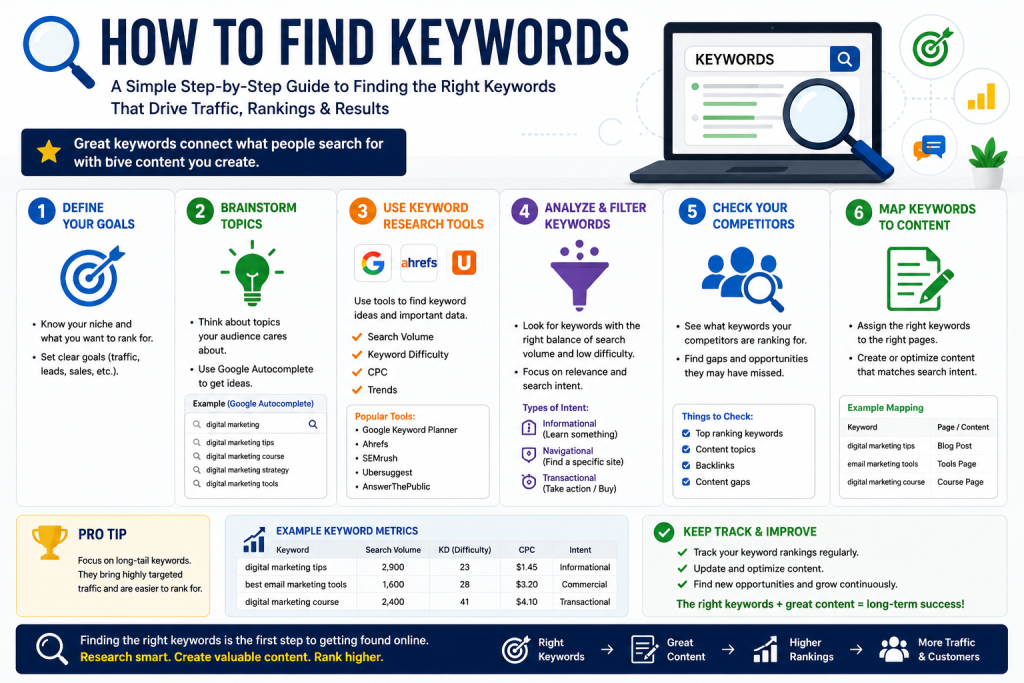
How to Find Keywords
There are several ways to discover keywords for your website.
1. Start With Your Main Topic
Begin with a broad topic related to your business, website, or industry.
For example, a tree service company might start with:
Tree removal
From there, you can discover related searches such as:
- tree removal cost
- emergency tree removal
- tree removal near me
- tree removal services
- how much does tree removal cost
These related terms provide ideas for website pages and blog articles.
2. Use Keyword Research Tools
Keyword research tools can provide information about search volume, competition, related keywords, and other useful metrics.
Popular tools include Google Keyword Planner, Semrush, Ahrefs, and other SEO platforms.
Don’t rely on a single metric when choosing keywords. A keyword with lower search volume can sometimes be more valuable than a high-volume keyword if it has strong commercial intent and matches your business.
Understand Search Intent
Search intent describes the reason behind a search.
There are four common types of search intent:
Informational: The user wants information.
Example: “How does SEO work?”
Navigational: The user wants to find a specific website or page.
Example: “Google Search Console.”
Commercial: The user is researching products or services before making a decision.
Example: “best CRM for small business.”
Transactional: The user is ready to take action.
Example: “buy running shoes online.”
Understanding intent helps you create content that actually satisfies what searchers need.
Focus on Long-Tail Keywords
Long-tail keywords are longer and more specific search phrases.
For example:
Short keyword:
“plumber”
Long-tail keyword:
“emergency plumber in Austin TX”
Long-tail keywords often have less competition and can provide highly relevant traffic because they describe a more specific need.
For U.S. businesses, combining services with locations can be particularly useful when the business serves a defined geographic market.
Check Keyword Competition
Before targeting a keyword, consider how difficult it may be to compete.
Search the keyword on Google and examine the results. Look at the quality and authority of the websites ranking on the first page.
If the results are dominated by major national brands and highly authoritative websites, a new website may have difficulty ranking quickly.
In that situation, consider targeting a more specific variation or a related long-tail keyword.
Use Keywords Naturally in Your Content
Once you select your keywords, use them naturally.
Important places can include:
- Page title
- H1 heading
- Introduction
- Subheadings
- URL
- Meta description
- Image alt text
- Body content
- Internal links
However, don’t repeat keywords unnaturally. Keyword stuffing can make content difficult to read and does not create a better user experience.
Your primary goal should be to answer the user’s question clearly and completely.
Build Keyword Clusters
Instead of creating a separate page for every small keyword variation, organize related keywords into topic groups.
For example, a page about tree removal cost could naturally address:
- average tree removal cost
- tree size and removal price
- emergency tree removal cost
- tree removal factors
- local tree removal prices
This approach allows one comprehensive page to address multiple closely related searches.
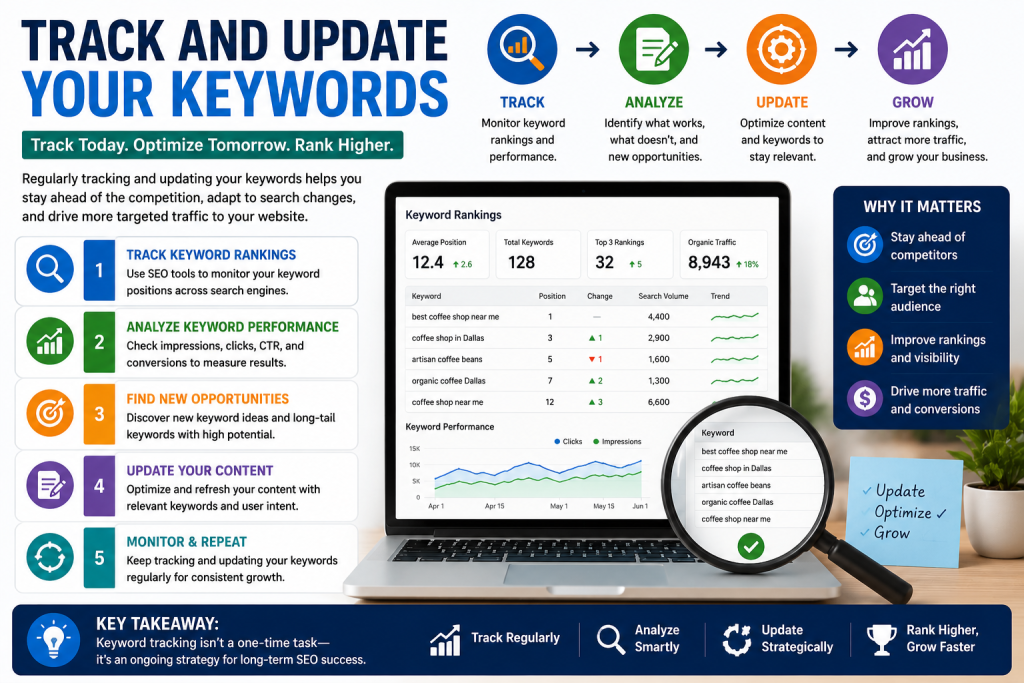
Track and Update Your Keywords
Keyword research shouldn’t happen only once.
Monitor your website’s search performance and identify pages that are gaining impressions or rankings. You can then improve those pages with better information, clearer explanations, updated statistics, additional relevant topics, and stronger internal links.
SEO changes over time, so regularly reviewing your keyword strategy can help your website remain competitive.
Final Thoughts
This Keyword Research Guide shows that effective keyword research is about more than finding popular search terms. It’s about understanding your audience, identifying search intent, evaluating competition, and creating content that genuinely answers people’s questions.
For U.S. website owners and businesses in 2026, start with relevant topics, explore specific long-tail keywords, understand what searchers want, and organize related terms into useful content.
When keyword research and high-quality content work together, your website has a stronger foundation for attracting relevant organic search traffic.
Leave a Reply