Tag: Local SEO Guide

  • Keyword Research in 2026: The Complete Guide to Finding Better Keywords

    Keyword Research in 2026: The Complete Guide to Finding Better Keywords

    Keyword Research Guide: How to Find the Right Keywords in 2026

    If you want your website to attract organic traffic from Google, keyword research is one of the first SEO skills you should learn. Choosing the right keywords helps you understand what your target audience is searching for and what type of content you should create.

    This Keyword Research Guide explains how keyword research works, how to find valuable search terms, how to understand search intent, and how U.S. businesses and website owners can use keywords to build a stronger SEO strategy in 2026.

    What Is Keyword Research?

    Keyword research is the process of finding and analyzing the words and phrases people enter into search engines.

    For example, someone looking for a local roofing company might search for:

    • “roof repair near me”
    • “roof replacement cost”
    • “best roofing company Dallas”
    • “emergency roof repair”
    • “how much does a new roof cost”

    These searches provide valuable information about what potential customers want to know or buy.

    The goal of keyword research isn’t simply to find keywords with the highest search volume. Instead, you want to identify keywords that are relevant, useful, and connected to your audience’s search intent.

    Why Is Keyword Research Important in 2026?

    Search engines are becoming better at understanding topics, context, and user intent. This makes strategic keyword research more important than simply repeating an exact phrase throughout an article.

    Effective keyword research can help you:

    • Discover content opportunities
    • Understand your audience
    • Attract relevant organic traffic
    • Improve content planning
    • Find potential customers
    • Identify competitive topics
    • Build topic authority

    For U.S. businesses, keyword research can also reveal valuable location-based searches that help connect your website with customers in specific cities and states.
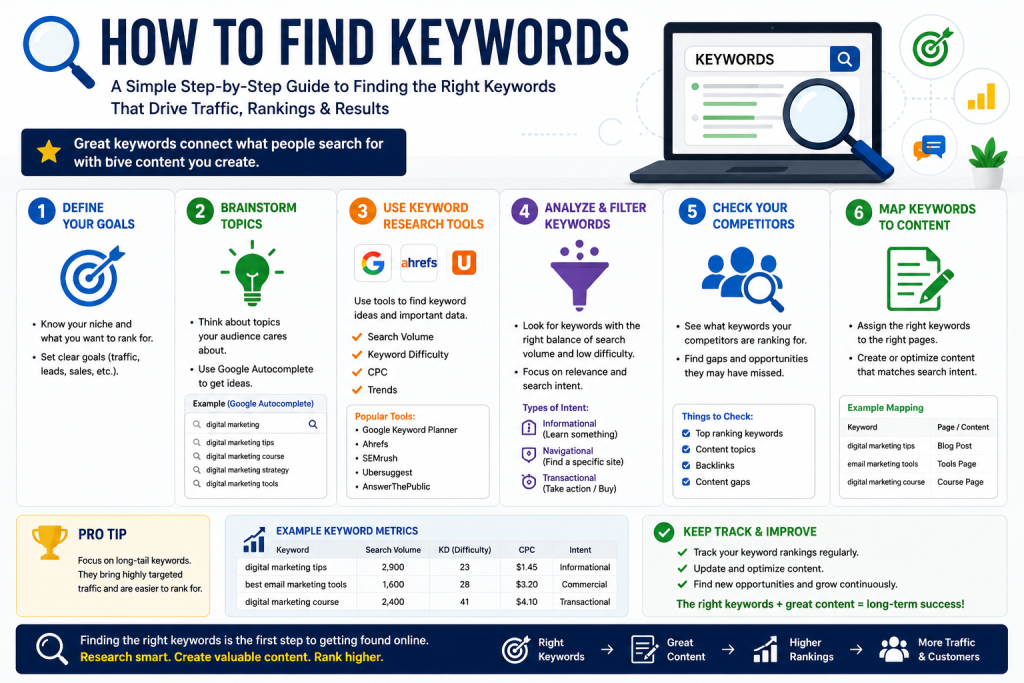
    How to find keywords using keyword research tools, search intent, competitor analysis, and keyword mapping

    How to Find Keywords

    There are several ways to discover keywords for your website.

    1. Start With Your Main Topic

    Begin with a broad topic related to your business, website, or industry.

    For example, a tree service company might start with:

    Tree removal

    From there, you can discover related searches such as:

    • tree removal cost
    • emergency tree removal
    • tree removal near me
    • tree removal services
    • how much does tree removal cost

    These related terms provide ideas for website pages and blog articles.

    2. Use Keyword Research Tools

    Keyword research tools can provide information about search volume, competition, related keywords, and other useful metrics.

    Popular tools include Google Keyword Planner, Semrush, Ahrefs, and other SEO platforms.

    Don’t rely on a single metric when choosing keywords. A keyword with lower search volume can sometimes be more valuable than a high-volume keyword if it has strong commercial intent and matches your business.

    Understand Search Intent

    Search intent describes the reason behind a search.

    There are four common types of search intent:

    Informational: The user wants information.

    Example: “How does SEO work?”

    Navigational: The user wants to find a specific website or page.

    Example: “Google Search Console.”

    Commercial: The user is researching products or services before making a decision.

    Example: “best CRM for small business.”

    Transactional: The user is ready to take action.

    Example: “buy running shoes online.”

    Understanding intent helps you create content that actually satisfies what searchers need.

    Focus on Long-Tail Keywords

    Long-tail keywords are longer and more specific search phrases.

    For example:

    Short keyword:
    “plumber”

    Long-tail keyword:
    “emergency plumber in Austin TX”

    Long-tail keywords often have less competition and can provide highly relevant traffic because they describe a more specific need.

    For U.S. businesses, combining services with locations can be particularly useful when the business serves a defined geographic market.

    Check Keyword Competition

    Before targeting a keyword, consider how difficult it may be to compete.

    Search the keyword on Google and examine the results. Look at the quality and authority of the websites ranking on the first page.

    If the results are dominated by major national brands and highly authoritative websites, a new website may have difficulty ranking quickly.

    In that situation, consider targeting a more specific variation or a related long-tail keyword.

    Use Keywords Naturally in Your Content

    Once you select your keywords, use them naturally.

    Important places can include:

    • Page title
    • H1 heading
    • Introduction
    • Subheadings
    • URL
    • Meta description
    • Image alt text
    • Body content
    • Internal links

    However, don’t repeat keywords unnaturally. Keyword stuffing can make content difficult to read and does not create a better user experience.

    Your primary goal should be to answer the user’s question clearly and completely.

    Build Keyword Clusters

    Instead of creating a separate page for every small keyword variation, organize related keywords into topic groups.

    For example, a page about tree removal cost could naturally address:

    • average tree removal cost
    • tree size and removal price
    • emergency tree removal cost
    • tree removal factors
    • local tree removal prices

    This approach allows one comprehensive page to address multiple closely related searches.
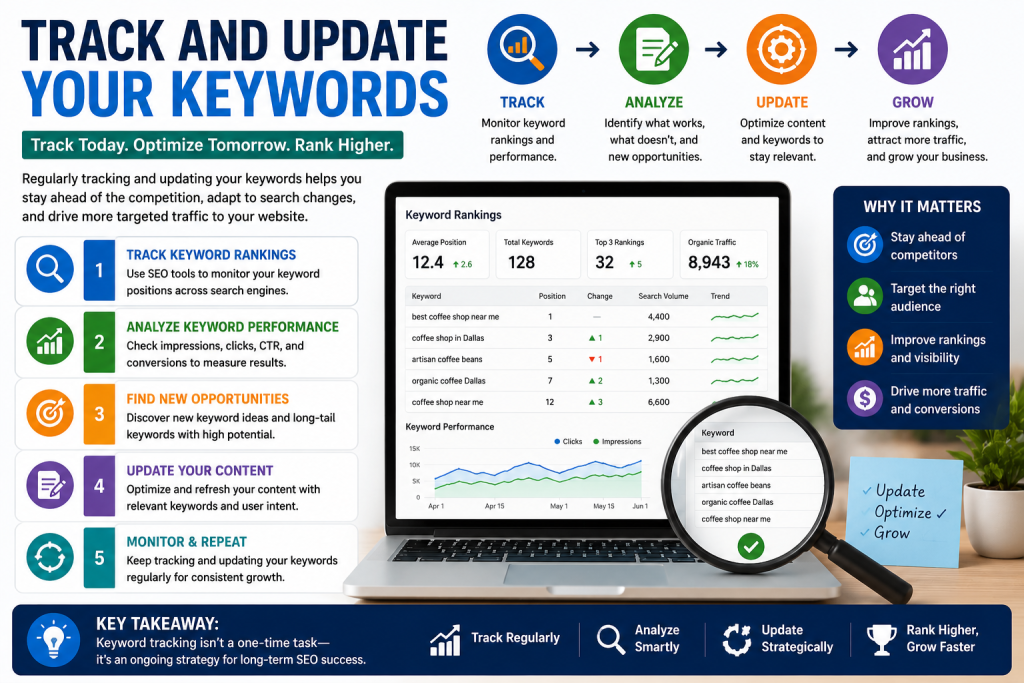
    Track and update SEO keywords using keyword rankings, performance analysis, content optimization, and search data

    Track and Update Your Keywords

    Keyword research shouldn’t happen only once.

    Monitor your website’s search performance and identify pages that are gaining impressions or rankings. You can then improve those pages with better information, clearer explanations, updated statistics, additional relevant topics, and stronger internal links.

    SEO changes over time, so regularly reviewing your keyword strategy can help your website remain competitive.

    Final Thoughts

    This Keyword Research Guide shows that effective keyword research is about more than finding popular search terms. It’s about understanding your audience, identifying search intent, evaluating competition, and creating content that genuinely answers people’s questions.

    For U.S. website owners and businesses in 2026, start with relevant topics, explore specific long-tail keywords, understand what searchers want, and organize related terms into useful content.

    When keyword research and high-quality content work together, your website has a stronger foundation for attracting relevant organic search traffic.
  • Local SEO Guide: Complete 2026

    Local SEO Guide: Complete 2026

    Local SEO Guide: How to Rank Your Business in Google in 2026

    If you own a business that serves customers in a specific city, town, or service area, local SEO Guide can help more people find your business when they search online. Whether you run a plumbing company in Texas, a dental office in Chicago, or a landscaping business in Florida, appearing in local search results can bring valuable traffic, leads, and customers.

    This Local SEO Guide explains the most important local search optimization strategies for U.S. businesses in 2026. You will learn how local SEO works, how to optimize your Google Business Profile, how to build local authority, and how to improve your website for location-based searches.

    What Is Local SEO?

    Local SEO is the process of optimizing your online presence so your business can appear for searches connected to a specific geographic location.

    For example, a customer might search for:

    • “plumber near me”
    • “best dentist in Chicago”
    • “tree removal Dallas TX”
    • “HVAC company near me”
    • “roofing contractor in Houston”

    Search engines use various signals to determine which local businesses are relevant to these searches.

    Why Is Local SEO Important in 2026?

    For many U.S. businesses, customers search online before calling, visiting, or purchasing from a local company.

    A strong local SEO Guide strategy can help your business:

    • Increase local visibility
    • Generate more website traffic
    • Attract nearby customers
    • Increase phone calls and inquiries
    • Improve online credibility
    • Compete with other local businesses
    • Generate more qualified leads

    For service-area businesses, local search visibility can be particularly valuable because people often search for services when they have an immediate need.

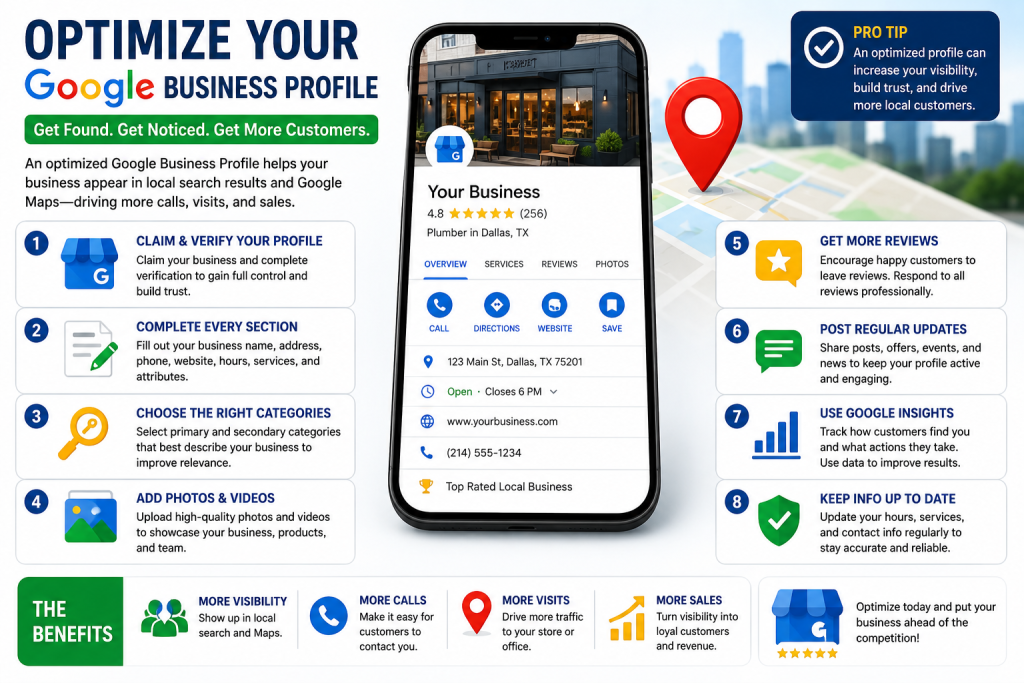
    Optimize Google Business Profile with local SEO tips, reviews, business information, photos, and Google Insights

    Optimize Your Google Business Profile

    One of the most important steps in this Local SEO Guide is optimizing your Google Business Profile.

    Your profile should contain accurate and complete information, including:

    • Business name
    • Primary business category
    • Phone number
    • Website
    • Business hours
    • Service areas
    • Business description
    • Photos
    • Services

    Keep your information accurate and update your profile when something changes.

    Use Local Keywords on Your Website

    Keyword research is another important part of local SEO Guide.

    Instead of targeting only broad keywords such as “tree service,” a Dallas tree company could target phrases such as:

    • “tree service Dallas”
    • “tree removal Dallas TX”
    • “emergency tree removal Dallas”
    • “tree trimming in Dallas”

    Use location keywords naturally in relevant page titles, headings, content, URLs, and image alt text.

    Create Location-Specific Content

    Creating useful local content can help local SEO Guide your website become more relevant to your target market.

    For example, a landscaping company could publish articles such as:

    • Best Landscaping Plants for Texas Homes
    • How Often Should You Trim Trees in Dallas?
    • Common Lawn Problems in Florida
    • How Much Does Tree Removal Cost in Houston?

    Build Local Citations

    Local citations are online mentions of your business local SEO Guide that generally include information such as its name, address, and phone number.

    Examples can include relevant business directories, industry websites, local organizations, and other reputable platforms.

    Do not create hundreds of low-quality directory listings simply to gain links. Focus on trustworthy and relevant sources.

    Get Genuine Customer Reviews

    Customer reviews can play an important role in your local online presence.

    Encourage satisfied customers to leave honest reviews about their actual experience. Make it easy for customers to find your review profile after completing a service.

    Never buy fake reviews or create reviews for local SEO Guide your own business. Authentic customer feedback is much more valuable for long-term reputation building.

    Earn Local Backlinks

    Backlinks are links from other websites to your website.

    For local businesses, relevant links from local newspapers, community organizations, industry associations, chambers of commerce, local publications, and online authority.

    The goal should be quality and relevance, for local SEO Guide not simply collecting as many links as possible.

    Make Your Website Mobile-Friendly

    Many local searches happen on smartphones. Your website should therefore work properly on mobile devices.

    Make sure visitors can quickly:

    • Find your phone number
    • Request a quote
    • Find your address
    • View your services
    • Read important information
    • Navigate between pages

    A fast, easy-to-use website creates a better experience for local SEO Guide potential customers and supports your overall SEO strategy.

    Track Your Local SEO Performance

    SEO should be measured over time. Monitor important metrics such as organic traffic, search visibility, website leads, phone calls, direction requests, and conversions.

    Tools such as Google Search Console and Google Analytics can help you understand how visitors find and interact with your website.

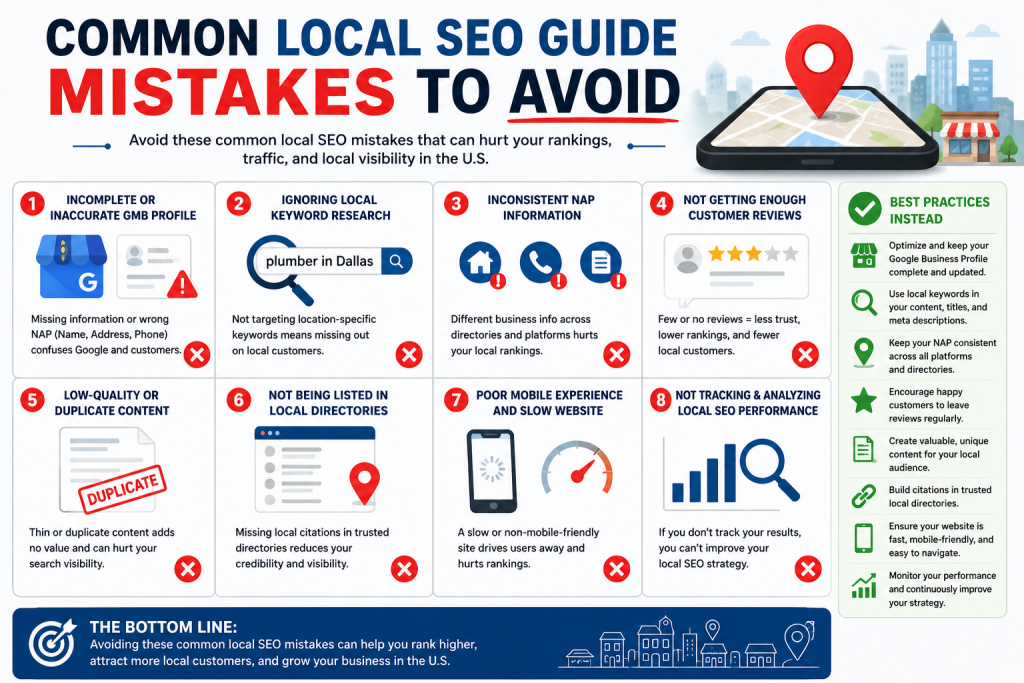
    Infographic highlighting common local SEO mistakes that can hurt U.S. business rankings, traffic, and local visibility, along with best practices for improving local search performance.

    Common Local SEO Guide Mistakes to Avoid

    Beginners often make these mistakes:

    • Using incorrect business information
    • Keyword stuffing city names
    • Buying fake reviews
    • Creating low-quality location pages
    • Ignoring mobile users
    • Building spammy backlinks
    • Neglecting their Google Business Profile
    • Expecting instant SEO results

    Local SEO is a long-term process. Consistency, relevance, useful content, and a strong customer experience are more sustainable than shortcuts.

    Final Thoughts

    This Local SEO Guide provides a practical starting point for U.S. businesses that want to improve their visibility in local search results in 2026.

    Start by optimizing your Google Business Profile, improving your website, targeting relevant local keywords, creating useful location-based content, earning genuine reviews, and building relationships with reputable local websites.

    The goal isn’t simply to rank higher. The goal is to help nearby customers discover your business when they are ready to take action.

    FAQs About Local SEO

    What is local SEO?

    Local SEO is the process of optimizing a business’s online presence to improve visibility for searches related to a specific geographic location.

    How long does local SEO take to work?

    Results vary based on competition, website authority, location, industry, and the quality of your SEO strategy. New businesses may need several months of consistent work to build meaningful visibility.

    Is local SEO important for small businesses?

    Yes. Local SEO can be especially valuable for small businesses that depend on customers within a particular city, region, or service area.

    Does Google Business Profile help with local SEO?

    A complete and accurate Google Business Profile is an important part of a local search strategy, particularly for businesses that interact with customers locally.