Author: Yasminawais5@gmail.com

  • Google Analytics 4 Guide (2026): Complete GA4 Tutorial for Beginners

    Google Analytics 4 Guide (2026): Complete GA4 Tutorial for Beginners

    Google Analytics 4 Guide (2026):

    If you want to understand your website visitors, improve marketing campaigns, and grow your business online, this Google Analytics 4 Guide is the perfect place to start. Google Analytics 4 (GA4) has become Google’s official analytics platform, replacing Universal Analytics with a smarter, event-based tracking system.

    Whether you run a small business, eCommerce store, blog, or enterprise website in the United States, this Google Analytics 4 Guide explains everything you need to know to make better data-driven decisions in 2026.


    What Is Google Analytics 4?

    Google Analytics 4 (GA4) is Google’s latest web analytics platform that helps businesses measure website traffic, user engagement, conversions, and customer behavior across websites and mobile apps.

    Unlike previous versions, GA4 uses event-based tracking instead of session-based tracking, giving marketers more accurate insights into how visitors interact with content.

    Using this Google Analytics 4 Guide, you’ll understand how GA4 helps improve SEO, advertising, and business performance.
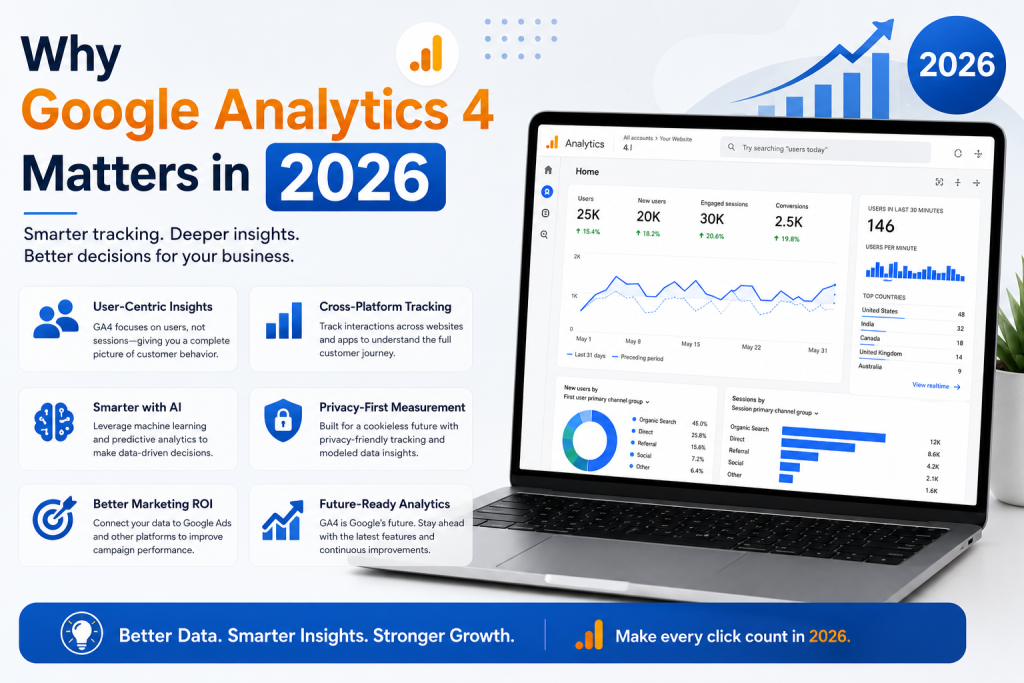

    Why Google Analytics 4 matters in 2026 with analytics dashboard, user insights, cross-platform tracking, AI, privacy, and marketing ROI

    Why Google Analytics 4 Matters in 2026

    Modern digital marketing depends on accurate data. This Google Analytics 4 Guide highlights why GA4 remains one of the most valuable free tools for website owners.

    Benefits include:

    • Better user behavior tracking
    • Cross-device reporting
    • AI-powered insights
    • Improved privacy controls
    • Advanced conversion tracking
    • Integration with Google Ads
    • Better SEO performance analysis

    For U.S. businesses competing online, GA4 provides the information needed to make smarter marketing decisions.


    How to Set Up Google Analytics 4

    Getting started with GA4 is straightforward.

    Step 1: Create a GA4 Property

    Sign in to your Google Analytics account and create a new GA4 property for your website.

    Step 2: Install the Tracking Code

    Add the Google tag to your website or use Google Tag Manager for easier management.

    Step 3: Verify Data Collection

    Open the Real-Time Report to confirm that GA4 is receiving visitor data correctly.

    Following this Google Analytics 4 Guide ensures your analytics setup is accurate from the beginning.


    Important GA4 Reports You Should Monitor

    GA4 offers several reports that provide valuable business insights.

    Real-Time Report

    Monitor live website visitors and user activity.

    Acquisition Report

    Discover where your visitors come from, including:

    • Organic Search
    • Paid Search
    • Social Media
    • Email Marketing
    • Referral Websites
    • Direct Traffic

    Engagement Report

    Measure:

    • Average engagement time
    • Events
    • Pages viewed
    • User interactions

    Conversion Report

    Track:

    • Purchases
    • Contact form submissions
    • Newsletter signups
    • Phone call clicks
    • Lead generation

    These reports make this Google Analytics 4 Guide essential for improving marketing performance.


    Best Practices for Using GA4

    To get the most value from Google Analytics, follow these recommendations:

    • Track meaningful events.
    • Set up conversion goals.
    • Connect Google Search Console.
    • Link Google Ads accounts.
    • Review reports weekly.
    • Create custom dashboards.
    • Filter internal traffic.
    • Monitor mobile performance.

    Consistent analysis helps businesses identify growth opportunities faster.


    Common Google Analytics 4 Mistakes

    Many beginners make avoidable mistakes.

    Avoid these issues:

    • Installing multiple tracking codes
    • Ignoring event tracking
    • Forgetting conversion setup
    • Not linking Search Console
    • Failing to exclude internal traffic
    • Never reviewing reports
    • Tracking unnecessary events

    Following this Google Analytics 4 Guide helps avoid these common errors.


    How GA4 Supports SEO

    SEO and analytics work together.

    GA4 helps measure:

    • Organic traffic growth
    • Landing page performance
    • User engagement
    • Bounce-related metrics
    • Conversion rates
    • Top-performing content

    Combining GA4 with Search Console provides a complete picture of your SEO performance.


    Essential Metrics to Watch

    Successful marketers regularly monitor:

    • Users
    • Sessions
    • Engaged Sessions
    • Engagement Rate
    • Average Engagement Time
    • Event Count
    • Conversions
    • Revenue
    • Organic Traffic
    • Returning Visitors

    Tracking these KPIs helps improve long-term website performance.
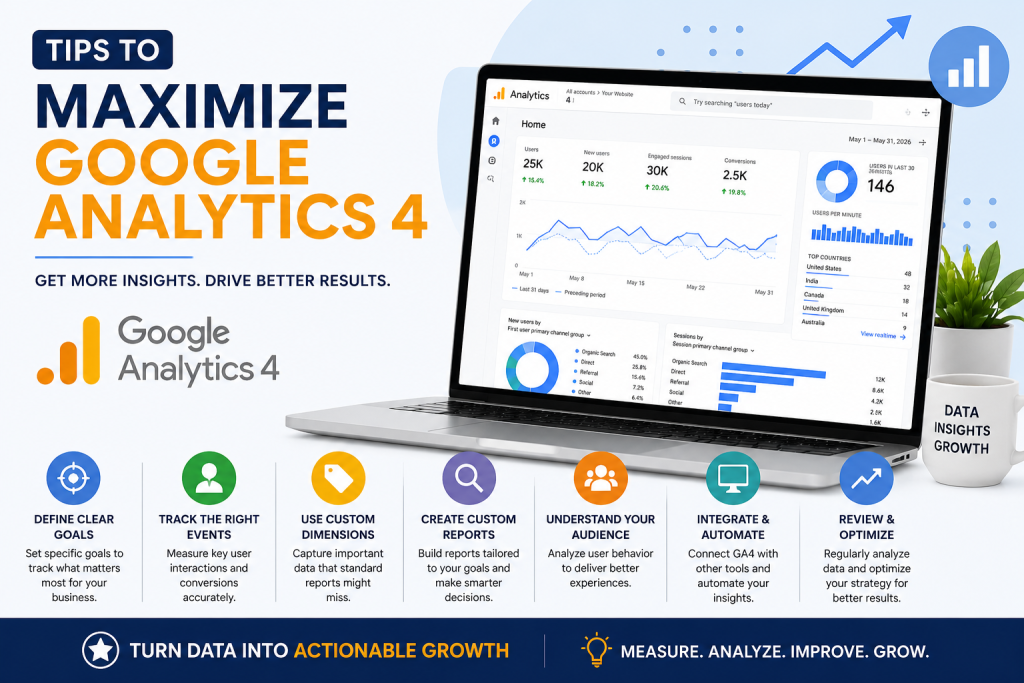

    Practical Google Analytics 4 tips to improve data tracking, understand user behavior, create custom reports, analyze audiences, and turn website data into actionable business insights.

    Tips to Maximize Google Analytics 4

    This Google Analytics 4 Guide recommends these practical strategies:

    • Review reports every week.
    • Compare month-over-month performance.
    • Use custom events.
    • Create audience segments.
    • Analyze high-converting pages.
    • Optimize low-performing pages.
    • Test marketing campaigns regularly.

    Small improvements based on data often produce significant business growth.


    Conclusion

    This Google Analytics 4 Guide demonstrates why GA4 remains one of the most powerful analytics platforms available in 2026. From tracking website visitors to measuring conversions and improving SEO performance, GA4 gives businesses the insights needed to make informed decisions. By implementing the strategies covered in this Google Analytics 4 Guide, you can better understand your audience, optimize marketing campaigns, and achieve sustainable online growth.


    Frequently Asked Questions (FAQs)

    What is Google Analytics 4?

    Google Analytics 4 is Google’s latest analytics platform that tracks website and app user behavior using an event-based data model.

    Is GA4 free?

    Yes. Google Analytics 4 is free for most website owners and includes powerful reporting and conversion tracking features.

    Why should I use Google Analytics 4?

    GA4 helps you measure website traffic, understand visitor behavior, improve SEO, optimize marketing campaigns, and increase conversions.

    Can GA4 improve SEO?

    Yes. GA4 provides valuable data about organic traffic, engagement, and user behavior that helps improve your SEO strategy.

    Is Google Analytics 4 difficult to learn?

    No. With regular use and proper setup, GA4 becomes easier to understand and provides actionable insights for businesses of all sizes.
  • Google Search Console Guide (2026): Complete SEO Tutorial

    Google Search Console Guide (2026): Complete SEO Tutorial

    Google Search Console Guide (2026): Complete Beginner’s SEO Guide

    If you want your website to rank higher on Google, following a Google Search Console Guide is one of the smartest decisions you can make. Whether you own a blog, an eCommerce store, or a business website in the United States, Google Search Console provides valuable insights into your site’s search performance.

    This Google Search Console Guide explains everything beginners need to know in 2026, from setting up your account to improving rankings and fixing SEO issues.


    What Is Google Search Console?

    Google Search Console is a free tool from Google that helps website owners monitor, maintain, and improve their visibility in Google Search results.

    Using this Google Search Console Guide, you’ll learn how to:

    • Track keyword rankings
    • Monitor website indexing
    • Find crawl errors
    • Submit XML sitemaps
    • Improve Core Web Vitals
    • Increase organic traffic

    For businesses targeting the U.S. market, Google Search Console is an essential part of every SEO strategy.


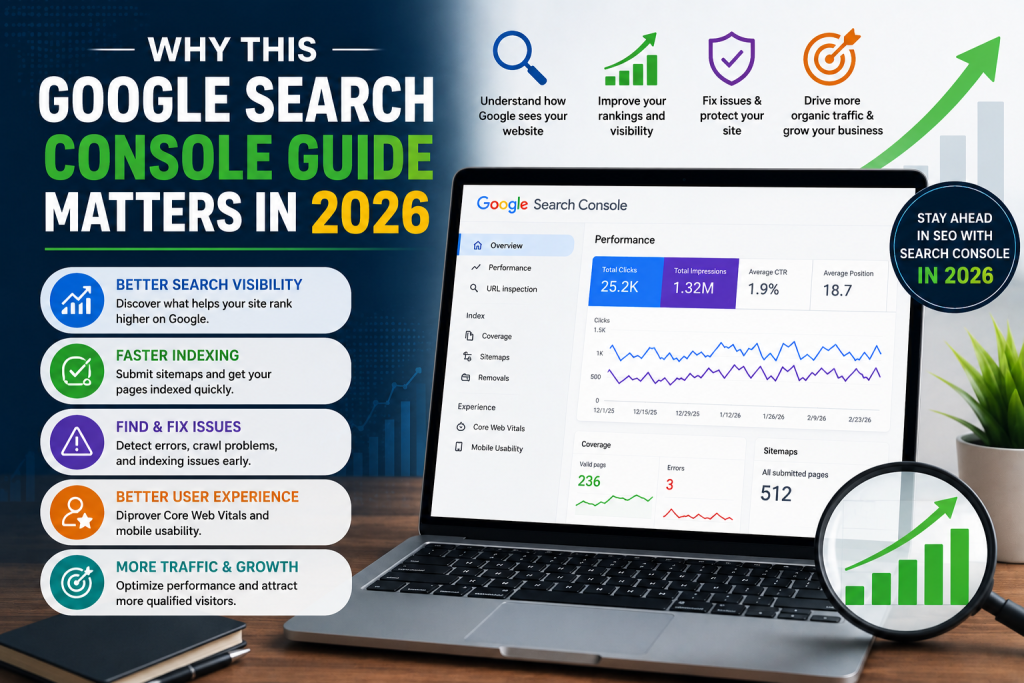
    Why Google Search Console Guide Matters in 2026 infographic showing Search Console dashboard, SEO analytics, indexing, website performance, and organic traffic growth.

    Why This Google Search Console Guide Matters in 2026

    Search engine optimization continues to evolve, and Google’s algorithms become smarter every year. Following a reliable Google Search Console Guide helps you understand how Google views your website.

    Benefits include:

    • Better search visibility
    • Faster indexing
    • Improved user experience
    • Higher click-through rates (CTR)
    • Better keyword optimization
    • Stronger technical SEO

    Whether you’re a beginner or an experienced marketer, Search Console provides data that can improve your rankings.


    How to Set Up Google Search Console

    This Google Search Console Guide recommends completing these steps first.

    1. Verify Your Website

    Choose one of these verification methods:

    DNS verification is usually the best long-term option.

    2. Submit Your XML Sitemap

    Navigate to the Sitemap section and submit:

    This helps Google discover your pages more efficiently.

    3. Wait for Data Collection

    Google usually starts collecting performance data within a few days.


    Understanding the Performance Report

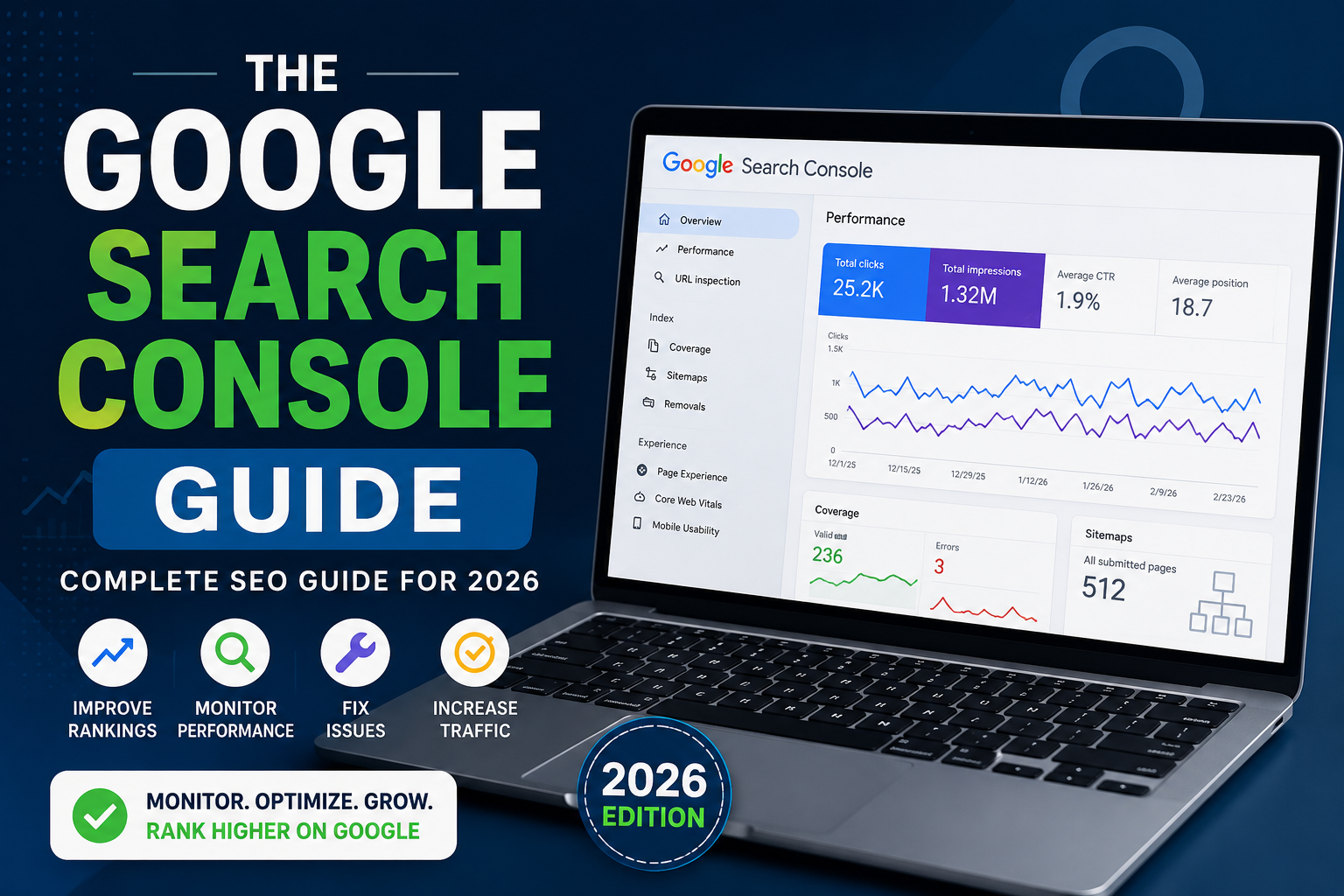
    One of the most useful parts of this Google Search Console Guide is learning how to read the Performance report.

    You’ll see important metrics such as:

    • Total Clicks
    • Total Impressions
    • Average CTR
    • Average Position

    These metrics help you understand:

    • Which keywords bring traffic
    • Which pages perform best
    • Which pages need optimization

    Review these reports regularly to improve your SEO strategy.


    Fix Indexing Problems

    Many websites lose traffic because important pages are not indexed.

    This Google Search Console Guide recommends checking the Pages report frequently.

    Common indexing issues include:

    • Noindex tags
    • Blocked robots.txt files
    • Redirect errors
    • Duplicate pages
    • Soft 404 pages
    • Server errors

    Fixing these issues can significantly improve search visibility.


    Improve Core Web Vitals

    Google considers page experience a ranking factor.

    The Core Web Vitals report measures:

    • Largest Contentful Paint (LCP)
    • Interaction to Next Paint (INP)
    • Cumulative Layout Shift (CLS)

    Improving these metrics helps increase rankings while providing a better user experience.


    Monitor Mobile Usability

    Most U.S. users browse on smartphones.

    A complete Google Search Console Guide always recommends checking mobile usability to ensure your website:

    • Loads quickly
    • Uses responsive design
    • Has readable text
    • Features clickable buttons
    • Avoids layout issues

    Mobile-friendly websites often perform better in Google Search.


    Use URL Inspection

    The URL Inspection Tool is one of Search Console’s most valuable features.

    It allows you to:

    • Check if a page is indexed
    • Request indexing
    • View crawl status
    • Detect indexing issues
    • Test live URLs

    Whenever you publish new content, use this feature to request faster indexing.


    Monitor Backlinks

    Another useful feature in this Google Search Console Guide is the Links report.

    You can view:

    • Top linked pages
    • External backlinks
    • Internal links
    • Top linking websites

    Monitoring backlinks helps you understand your website’s authority and identify opportunities for stronger internal linking.


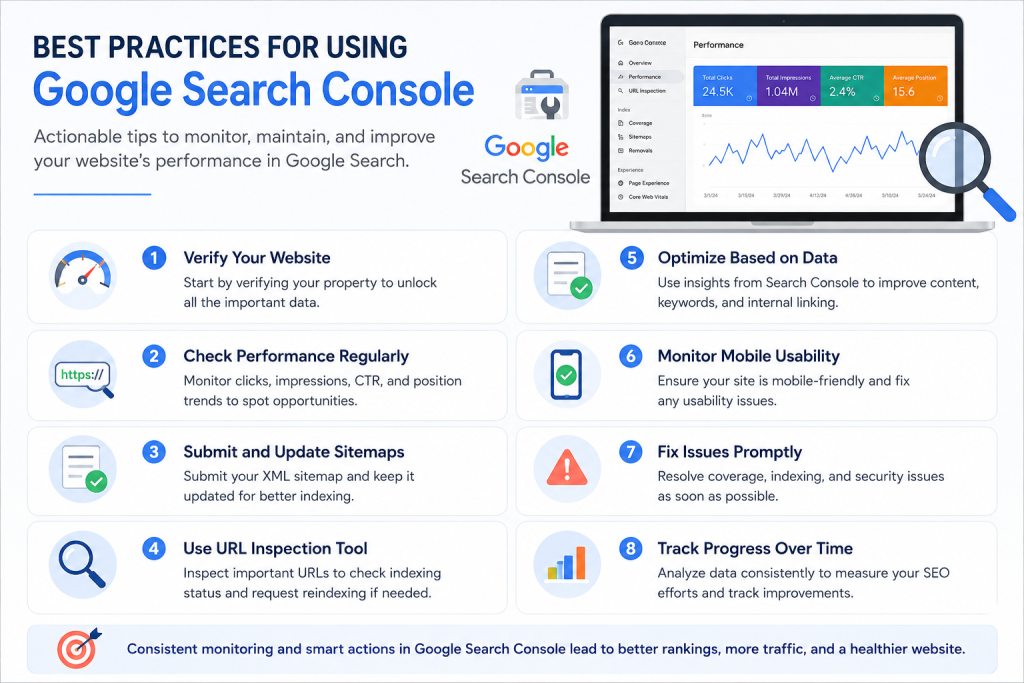
    An infographic showing the best practices for using Google Search Console, including monitoring performance, submitting sitemaps, checking URLs, fixing indexing issues, improving mobile usability, and tracking SEO progress.

    Best Practices for Using Google Search Console

    To maximize SEO success:

    • Check reports every week.
    • Submit updated sitemaps after major changes.
    • Monitor indexing regularly.
    • Fix crawl errors immediately.
    • Improve low-CTR pages.
    • Optimize pages with high impressions but low clicks.
    • Review Core Web Vitals monthly.
    • Track keyword performance consistently.

    Following these habits helps maintain healthy website performance.


    Common Mistakes to Avoid

    Even experienced website owners make mistakes.

    Avoid:

    • Ignoring indexing errors
    • Never checking Performance reports
    • Forgetting sitemap updates
    • Not fixing mobile issues
    • Ignoring Core Web Vitals
    • Requesting indexing repeatedly without changes
    • Failing to monitor backlinks

    Correcting these issues can lead to better search performance over time.


    Conclusion

    This Google Search Console Guide is one of the best resources for anyone who wants to improve SEO in 2026. From tracking keywords and monitoring indexing to fixing technical errors and improving Core Web Vitals, Google Search Console provides the insights needed to grow organic traffic. By following this Google Search Console Guide consistently, U.S. website owners can build stronger search visibility, improve rankings, and achieve long-term SEO success.


    Frequently Asked Questions

    What is Google Search Console used for?

    Google Search Console helps website owners monitor search performance, fix indexing issues, submit sitemaps, and improve SEO.

    Is Google Search Console free?

    Yes. Google Search Console is completely free for all website owners.

    How often should I check Google Search Console?

    Most SEO professionals recommend reviewing your reports at least once a week.

    Does Google Search Console improve rankings?

    It doesn’t directly improve rankings, but it helps identify SEO issues that can positively impact your search visibility.

    Can beginners use Google Search Console?

    Absolutely. This Google Search Console Guide is designed for beginners as well as experienced marketers.

  • Link Building Strategies: Best 2026 Guide to Earn Backlinks

    Link Building Strategies: Best 2026 Guide to Earn Backlinks

    Link Building Strategies: Complete Guide for Better SEO

    If you want your website to rank higher on Google in 2026, mastering Link Building Strategies is one of the smartest investments you can make. High-quality backlinks remain one of Google’s strongest ranking signals, helping websites build authority, improve trust, and attract more organic traffic.

    Whether you own a business website, blog, eCommerce store, or service-based company in the United States, using the right Link Building Strategies can significantly improve your online visibility without relying entirely on paid advertising.

    In this guide, you’ll learn proven, white-hat techniques that continue to deliver results while following Google’s best practices.


    Why Link Building Still Matters in 2026

    Google evaluates hundreds of ranking factors, but backlinks continue to play an important role. A backlink acts like a recommendation from another website. The more trustworthy websites that link to your content, the more credibility your website gains.

    Modern Link Building Strategies focus on earning links naturally instead of manipulating search engines. Quality always beats quantity.

    Benefits include:

    • Higher Google rankings
    • Increased website authority
    • More organic traffic
    • Better brand credibility
    • Faster indexing of new pages
    • More referral visitors

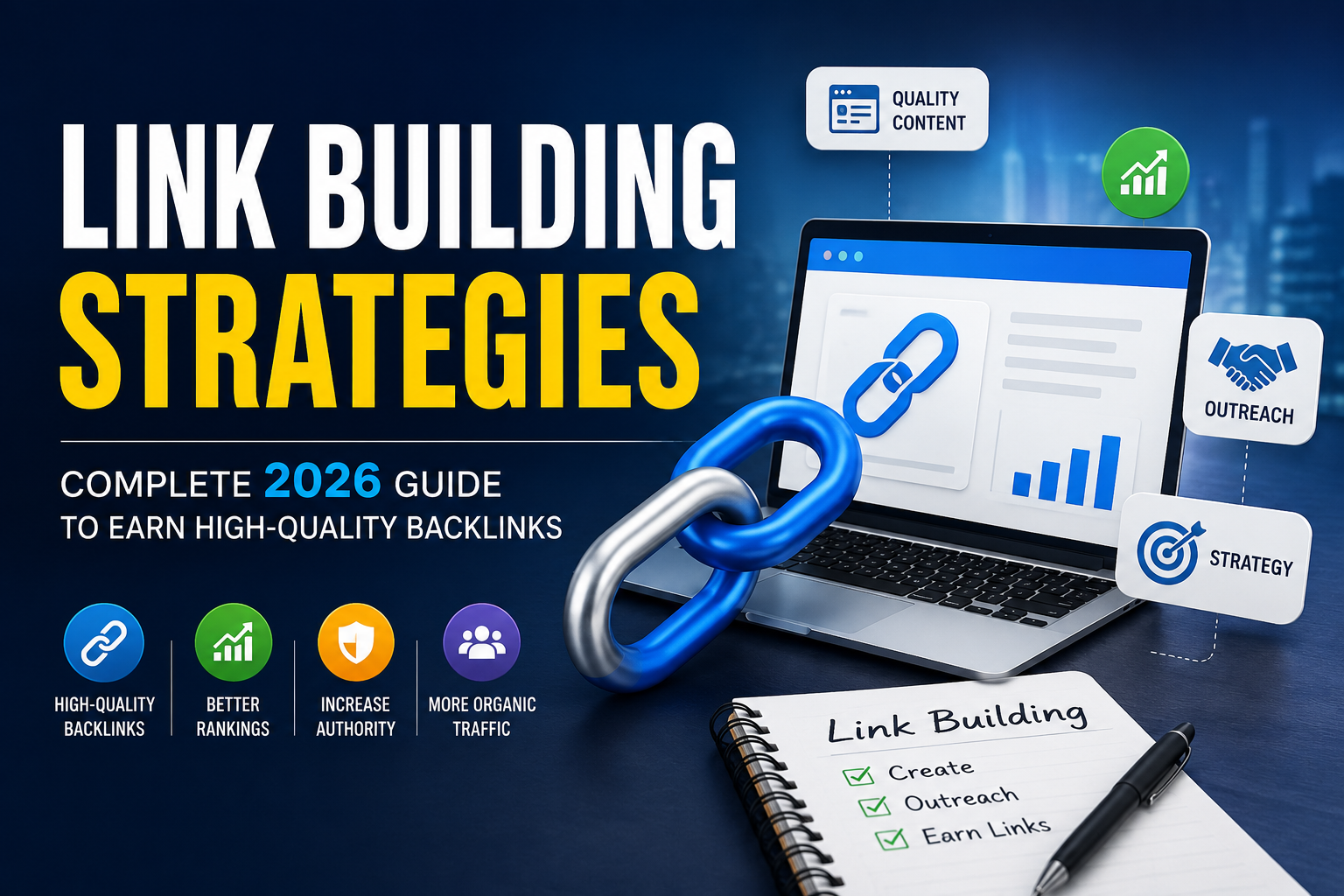
    Best Link Building Strategies for long-term SEO success with quality backlinks, content marketing, outreach, and website authority growth.

    Best Link Building Strategies for Long-Term SEO Success

    Here are the most effective Link Building Strategies that work for businesses targeting the U.S. market.

    1. Create High-Quality Content

    Exceptional content naturally attracts backlinks.

    Publish:

    • Complete guides
    • Original research
    • Industry statistics
    • Case studies
    • Helpful tutorials
    • Free tools
    • Infographics

    People link to content that solves real problems.


    2. Guest Posting on Authority Websites

    Guest blogging remains one of the safest and most effective Link Building Strategies when done correctly.

    Choose websites that:

    • Have real traffic
    • Are relevant to your industry
    • Publish original content
    • Maintain editorial standards

    Focus on providing value rather than simply getting a backlink.


    3. Build Resource Page Links

    Many universities, organizations, and businesses maintain helpful resource pages.

    Find pages related to your niche and recommend your useful content if it genuinely adds value.

    These backlinks often come from highly trusted websites.


    4. Broken Link Building

    Broken link building involves finding dead links on other websites and suggesting your relevant content as a replacement.

    This approach benefits both parties:

    • Website owners fix broken pages.
    • You earn quality backlinks.

    It’s one of the most effective white-hat Link Building Strategies available today.


    5. Digital PR Campaigns

    Digital PR has become increasingly valuable in 2026.

    Create newsworthy content such as:

    • Industry reports
    • Survey results
    • Company milestones
    • Trend analysis
    • Expert opinions

    Journalists and bloggers often reference valuable data sources with backlinks.


    6. Local Link Building

    For businesses serving U.S. customers, local SEO is essential.

    Earn backlinks from:

    • Local business directories
    • Chambers of commerce
    • Community organizations
    • Local newspapers
    • Business associations
    • Sponsorship opportunities

    Local links improve both authority and local search rankings.


    7. HARO and Expert Contributions

    Responding to journalist requests remains an excellent opportunity.

    When reporters quote your expertise, they often provide a backlink from high-authority news websites.

    Expert contributions help build both credibility and visibility.


    Common Link Building Mistakes to Avoid

    Avoid outdated SEO tactics that can hurt rankings.

    Never:

    • Buy backlinks
    • Participate in link farms
    • Use automated link software
    • Exchange excessive links
    • Create spammy directory links
    • Over-optimize anchor text

    Google continues to reward natural backlink profiles over artificial ones.


    Tools That Help with Link Building

    Several SEO tools simplify backlink research and outreach.

    Popular options include:

    • Ahrefs
    • Semrush
    • Moz Pro
    • Google Search Console
    • BuzzStream
    • Hunter.io
    • Pitchbox

    These platforms help identify backlink opportunities, monitor competitors, and manage outreach campaigns efficiently.


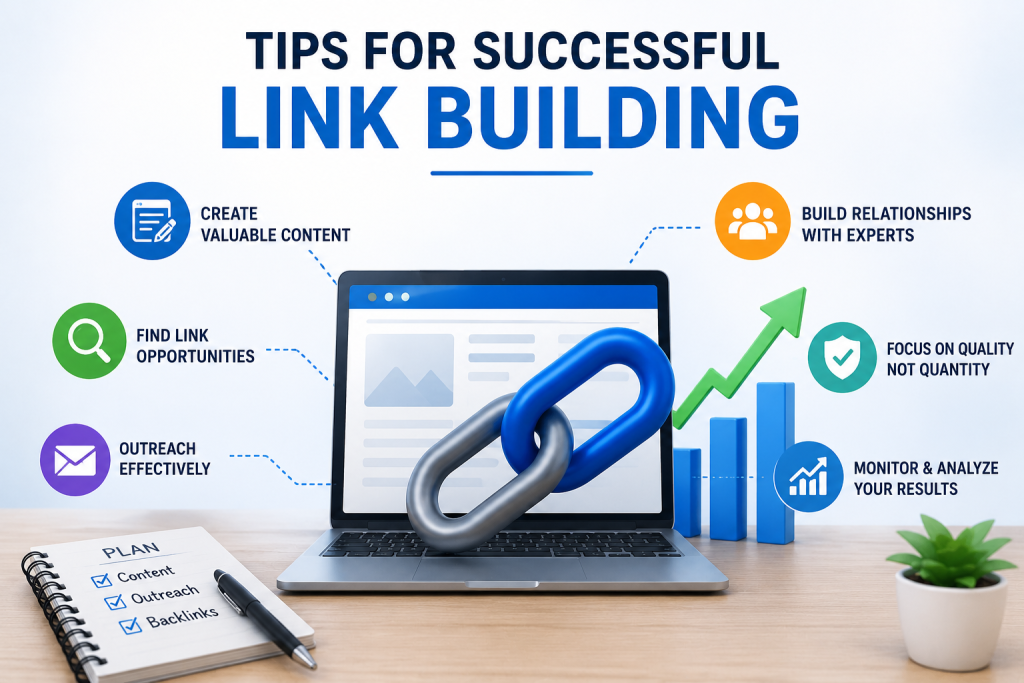
    Tips for Successful Link Building showing content creation, outreach, quality backlinks, SEO growth, and long-term website authority improvement.

    Tips for Successful Link Building

    Successful Link Building Strategies require patience and consistency.

    Follow these best practices:

    • Publish valuable content regularly.
    • Focus on quality instead of quantity.
    • Build relationships with industry websites.
    • Personalize outreach emails.
    • Monitor your backlink profile.
    • Remove harmful or spammy links.
    • Keep creating content worth referencing.

    SEO success comes from long-term authority rather than shortcuts.


    How Long Does Link Building Take?

    Many website owners expect immediate results, but SEO requires patience.

    Typically:

    • First backlinks: 2–8 weeks
    • Ranking improvements: 3–6 months
    • Significant authority growth: 6–12 months

    Consistent publishing and outreach produce the strongest long-term results.


    Conclusion

    In today’s competitive digital landscape, effective Link Building Strategies remain one of the most powerful ways to improve search rankings, increase authority, and attract qualified visitors. By focusing on quality content, ethical outreach, digital PR, guest posting, and local partnerships, businesses can build a strong backlink profile that supports sustainable growth. Start implementing these Link Building Strategies today, and you’ll position your website for greater SEO success throughout 2026 and beyond.


    Frequently Asked Questions (FAQs)

    What are link building strategies?

    Link building strategies are SEO techniques used to earn backlinks from other websites, helping improve search engine rankings and website authority.

    Are backlinks still important in 2026?

    Yes. High-quality backlinks remain one of Google’s most influential ranking factors when they come from relevant and trustworthy websites.

    What is the safest link building method?

    Creating valuable content that naturally earns backlinks, combined with guest posting and digital PR, is considered the safest approach.

    How many backlinks do I need?

    There is no fixed number. A few backlinks from authoritative websites are usually more valuable than hundreds of low-quality links.

    Can buying backlinks hurt SEO?

    Yes. Purchasing backlinks violates Google’s guidelines and may lead to ranking penalties or manual actions. Always focus on ethical, white-hat link building techniques.

  • Keyword Research in 2026: The Complete Guide to Finding Better Keywords

    Keyword Research in 2026: The Complete Guide to Finding Better Keywords

    Keyword Research Guide: How to Find the Right Keywords in 2026

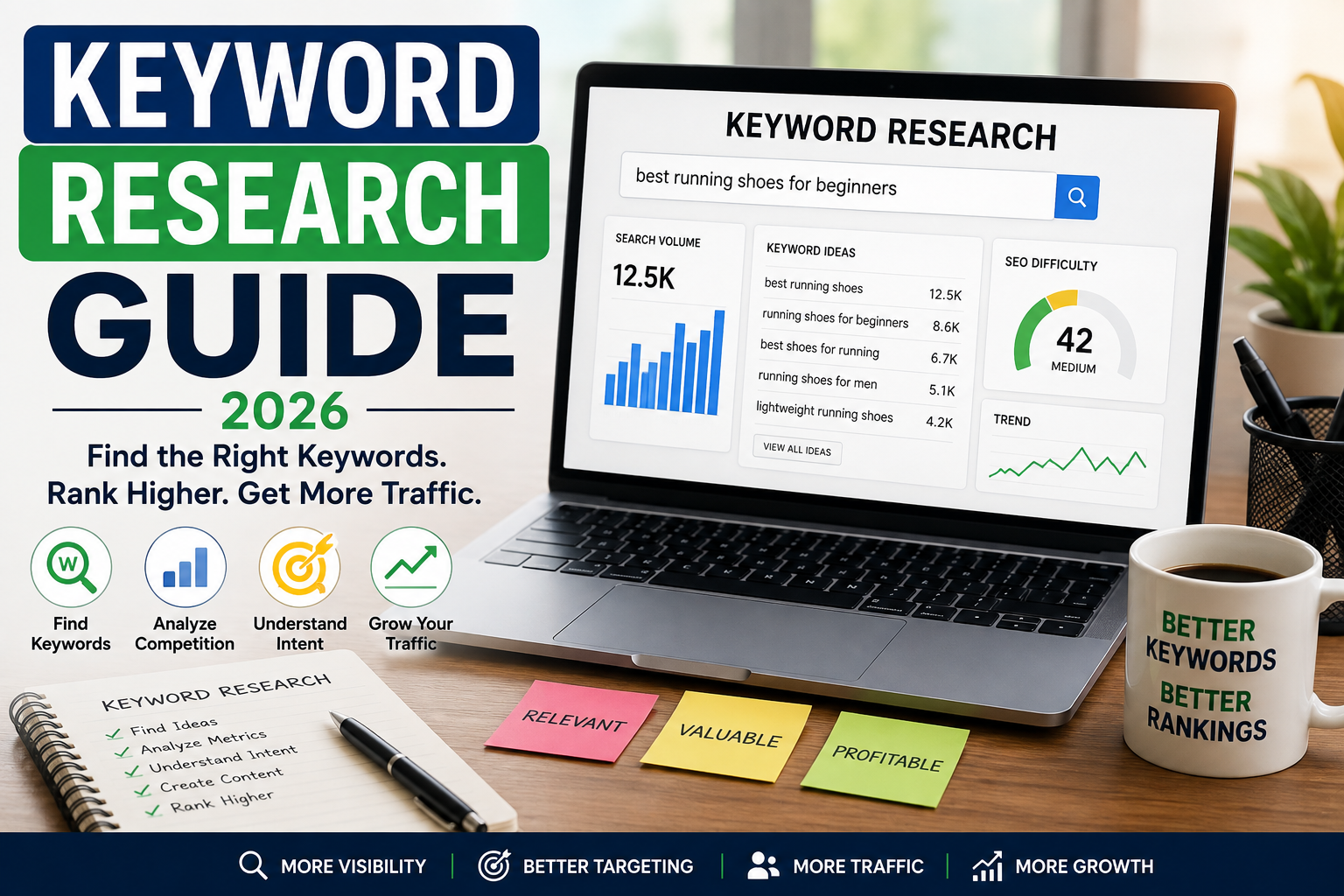
    If you want your website to attract organic traffic from Google, keyword research is one of the first SEO skills you should learn. Choosing the right keywords helps you understand what your target audience is searching for and what type of content you should create.

    This Keyword Research Guide explains how keyword research works, how to find valuable search terms, how to understand search intent, and how U.S. businesses and website owners can use keywords to build a stronger SEO strategy in 2026.

    What Is Keyword Research?

    Keyword research is the process of finding and analyzing the words and phrases people enter into search engines.

    For example, someone looking for a local roofing company might search for:

    • “roof repair near me”
    • “roof replacement cost”
    • “best roofing company Dallas”
    • “emergency roof repair”
    • “how much does a new roof cost”

    These searches provide valuable information about what potential customers want to know or buy.

    The goal of keyword research isn’t simply to find keywords with the highest search volume. Instead, you want to identify keywords that are relevant, useful, and connected to your audience’s search intent.

    Why Is Keyword Research Important in 2026?

    Search engines are becoming better at understanding topics, context, and user intent. This makes strategic keyword research more important than simply repeating an exact phrase throughout an article.

    Effective keyword research can help you:

    • Discover content opportunities
    • Understand your audience
    • Attract relevant organic traffic
    • Improve content planning
    • Find potential customers
    • Identify competitive topics
    • Build topic authority

    For U.S. businesses, keyword research can also reveal valuable location-based searches that help connect your website with customers in specific cities and states.

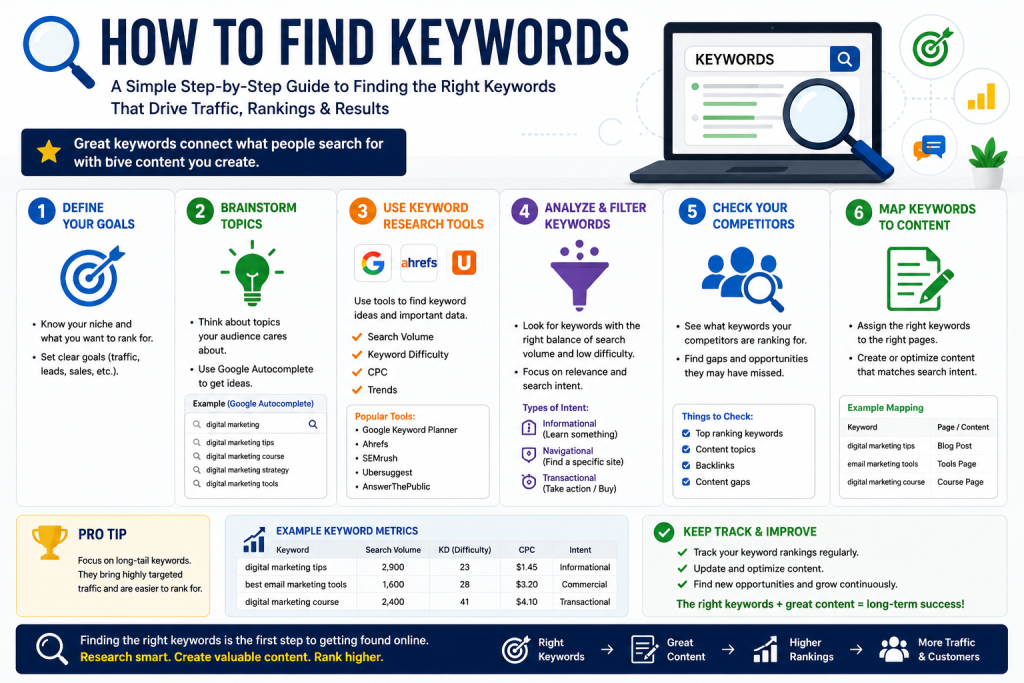
    How to find keywords using keyword research tools, search intent, competitor analysis, and keyword mapping

    How to Find Keywords

    There are several ways to discover keywords for your website.

    1. Start With Your Main Topic

    Begin with a broad topic related to your business, website, or industry.

    For example, a tree service company might start with:

    Tree removal

    From there, you can discover related searches such as:

    • tree removal cost
    • emergency tree removal
    • tree removal near me
    • tree removal services
    • how much does tree removal cost

    These related terms provide ideas for website pages and blog articles.

    2. Use Keyword Research Tools

    Keyword research tools can provide information about search volume, competition, related keywords, and other useful metrics.

    Popular tools include Google Keyword Planner, Semrush, Ahrefs, and other SEO platforms.

    Don’t rely on a single metric when choosing keywords. A keyword with lower search volume can sometimes be more valuable than a high-volume keyword if it has strong commercial intent and matches your business.

    Understand Search Intent

    Search intent describes the reason behind a search.

    There are four common types of search intent:

    Informational: The user wants information.

    Example: “How does SEO work?”

    Navigational: The user wants to find a specific website or page.

    Example: “Google Search Console.”

    Commercial: The user is researching products or services before making a decision.

    Example: “best CRM for small business.”

    Transactional: The user is ready to take action.

    Example: “buy running shoes online.”

    Understanding intent helps you create content that actually satisfies what searchers need.

    Focus on Long-Tail Keywords

    Long-tail keywords are longer and more specific search phrases.

    For example:

    Short keyword:
    “plumber”

    Long-tail keyword:
    “emergency plumber in Austin TX”

    Long-tail keywords often have less competition and can provide highly relevant traffic because they describe a more specific need.

    For U.S. businesses, combining services with locations can be particularly useful when the business serves a defined geographic market.

    Check Keyword Competition

    Before targeting a keyword, consider how difficult it may be to compete.

    Search the keyword on Google and examine the results. Look at the quality and authority of the websites ranking on the first page.

    If the results are dominated by major national brands and highly authoritative websites, a new website may have difficulty ranking quickly.

    In that situation, consider targeting a more specific variation or a related long-tail keyword.

    Use Keywords Naturally in Your Content

    Once you select your keywords, use them naturally.

    Important places can include:

    • Page title
    • H1 heading
    • Introduction
    • Subheadings
    • URL
    • Meta description
    • Image alt text
    • Body content
    • Internal links

    However, don’t repeat keywords unnaturally. Keyword stuffing can make content difficult to read and does not create a better user experience.

    Your primary goal should be to answer the user’s question clearly and completely.

    Build Keyword Clusters

    Instead of creating a separate page for every small keyword variation, organize related keywords into topic groups.

    For example, a page about tree removal cost could naturally address:

    • average tree removal cost
    • tree size and removal price
    • emergency tree removal cost
    • tree removal factors
    • local tree removal prices

    This approach allows one comprehensive page to address multiple closely related searches.

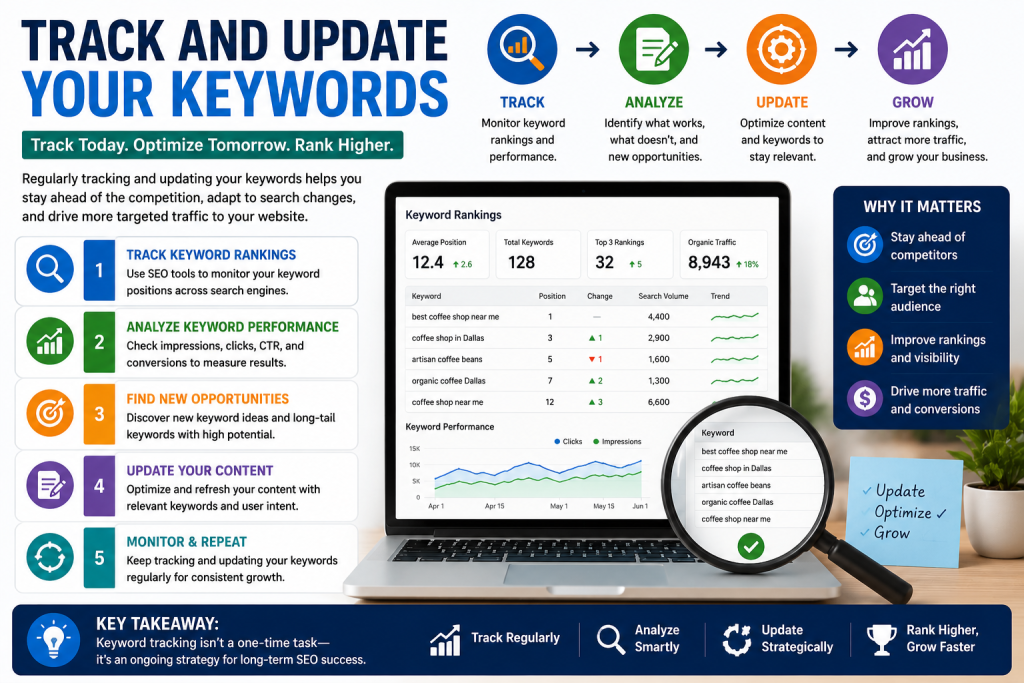
    Track and update SEO keywords using keyword rankings, performance analysis, content optimization, and search data

    Track and Update Your Keywords

    Keyword research shouldn’t happen only once.

    Monitor your website’s search performance and identify pages that are gaining impressions or rankings. You can then improve those pages with better information, clearer explanations, updated statistics, additional relevant topics, and stronger internal links.

    SEO changes over time, so regularly reviewing your keyword strategy can help your website remain competitive.

    Final Thoughts

    This Keyword Research Guide shows that effective keyword research is about more than finding popular search terms. It’s about understanding your audience, identifying search intent, evaluating competition, and creating content that genuinely answers people’s questions.

    For U.S. website owners and businesses in 2026, start with relevant topics, explore specific long-tail keywords, understand what searchers want, and organize related terms into useful content.

    When keyword research and high-quality content work together, your website has a stronger foundation for attracting relevant organic search traffic.

  • Local SEO Guide: Complete 2026

    Local SEO Guide: Complete 2026

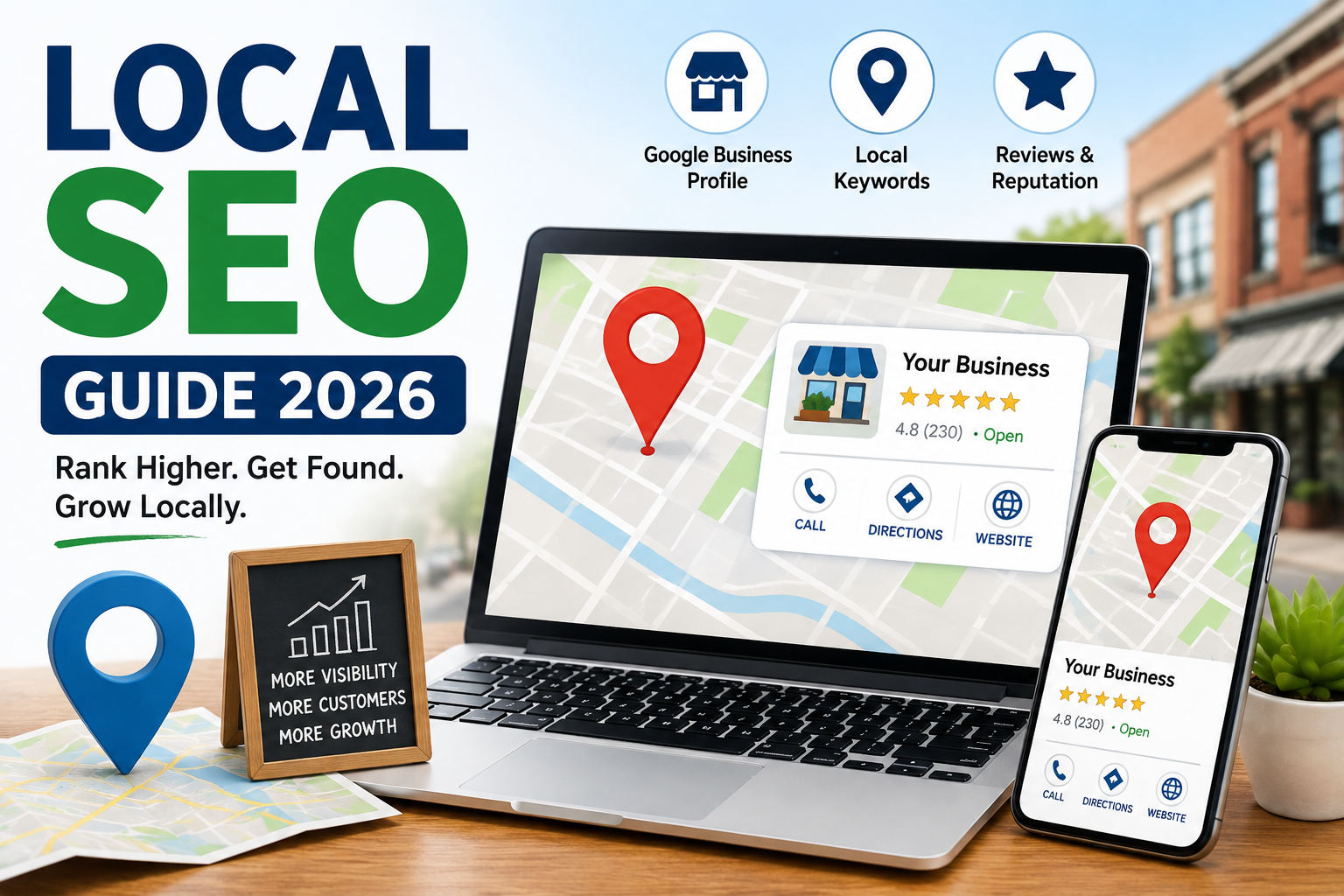
    Local SEO Guide: How to Rank Your Business in Google in 2026

    If you own a business that serves customers in a specific city, town, or service area, local SEO Guide can help more people find your business when they search online. Whether you run a plumbing company in Texas, a dental office in Chicago, or a landscaping business in Florida, appearing in local search results can bring valuable traffic, leads, and customers.

    This Local SEO Guide explains the most important local search optimization strategies for U.S. businesses in 2026. You will learn how local SEO works, how to optimize your Google Business Profile, how to build local authority, and how to improve your website for location-based searches.

    What Is Local SEO?

    Local SEO is the process of optimizing your online presence so your business can appear for searches connected to a specific geographic location.

    For example, a customer might search for:

    • “plumber near me”
    • “best dentist in Chicago”
    • “tree removal Dallas TX”
    • “HVAC company near me”
    • “roofing contractor in Houston”

    Search engines use various signals to determine which local businesses are relevant to these searches.

    Why Is Local SEO Important in 2026?

    For many U.S. businesses, customers search online before calling, visiting, or purchasing from a local company.

    A strong local SEO Guide strategy can help your business:

    • Increase local visibility
    • Generate more website traffic
    • Attract nearby customers
    • Increase phone calls and inquiries
    • Improve online credibility
    • Compete with other local businesses
    • Generate more qualified leads

    For service-area businesses, local search visibility can be particularly valuable because people often search for services when they have an immediate need.

    Optimize Google Business Profile with local SEO tips, reviews, business information, photos, and Google Insights

    Optimize Your Google Business Profile

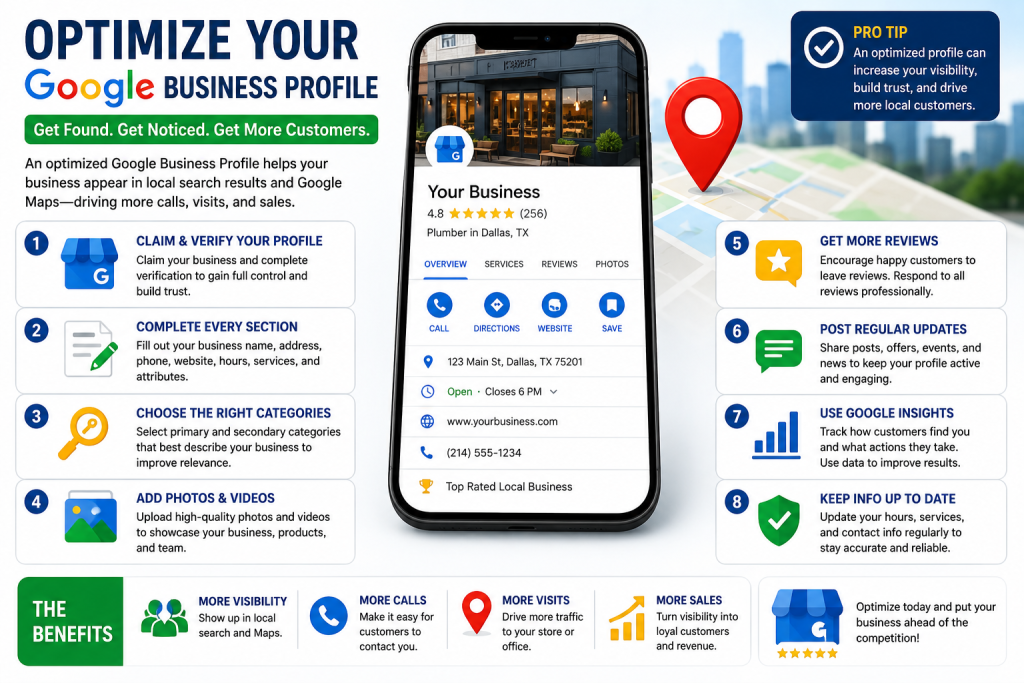
    One of the most important steps in this Local SEO Guide is optimizing your Google Business Profile.

    Your profile should contain accurate and complete information, including:

    • Business name
    • Primary business category
    • Phone number
    • Website
    • Business hours
    • Service areas
    • Business description
    • Photos
    • Services

    Keep your information accurate and update your profile when something changes.

    Use Local Keywords on Your Website

    Keyword research is another important part of local SEO Guide.

    Instead of targeting only broad keywords such as “tree service,” a Dallas tree company could target phrases such as:

    • “tree service Dallas”
    • “tree removal Dallas TX”
    • “emergency tree removal Dallas”
    • “tree trimming in Dallas”

    Use location keywords naturally in relevant page titles, headings, content, URLs, and image alt text.

    Create Location-Specific Content

    Creating useful local content can help local SEO Guide your website become more relevant to your target market.

    For example, a landscaping company could publish articles such as:

    • Best Landscaping Plants for Texas Homes
    • How Often Should You Trim Trees in Dallas?
    • Common Lawn Problems in Florida
    • How Much Does Tree Removal Cost in Houston?

    Build Local Citations

    Local citations are online mentions of your business local SEO Guide that generally include information such as its name, address, and phone number.

    Examples can include relevant business directories, industry websites, local organizations, and other reputable platforms.

    Do not create hundreds of low-quality directory listings simply to gain links. Focus on trustworthy and relevant sources.

    Get Genuine Customer Reviews

    Customer reviews can play an important role in your local online presence.

    Encourage satisfied customers to leave honest reviews about their actual experience. Make it easy for customers to find your review profile after completing a service.

    Never buy fake reviews or create reviews for local SEO Guide your own business. Authentic customer feedback is much more valuable for long-term reputation building.

    Earn Local Backlinks

    Backlinks are links from other websites to your website.

    For local businesses, relevant links from local newspapers, community organizations, industry associations, chambers of commerce, local publications, and online authority.

    The goal should be quality and relevance, for local SEO Guide not simply collecting as many links as possible.

    Make Your Website Mobile-Friendly

    Many local searches happen on smartphones. Your website should therefore work properly on mobile devices.

    Make sure visitors can quickly:

    • Find your phone number
    • Request a quote
    • Find your address
    • View your services
    • Read important information
    • Navigate between pages

    A fast, easy-to-use website creates a better experience for local SEO Guide potential customers and supports your overall SEO strategy.

    Track Your Local SEO Performance

    SEO should be measured over time. Monitor important metrics such as organic traffic, search visibility, website leads, phone calls, direction requests, and conversions.

    Tools such as Google Search Console and Google Analytics can help you understand how visitors find and interact with your website.

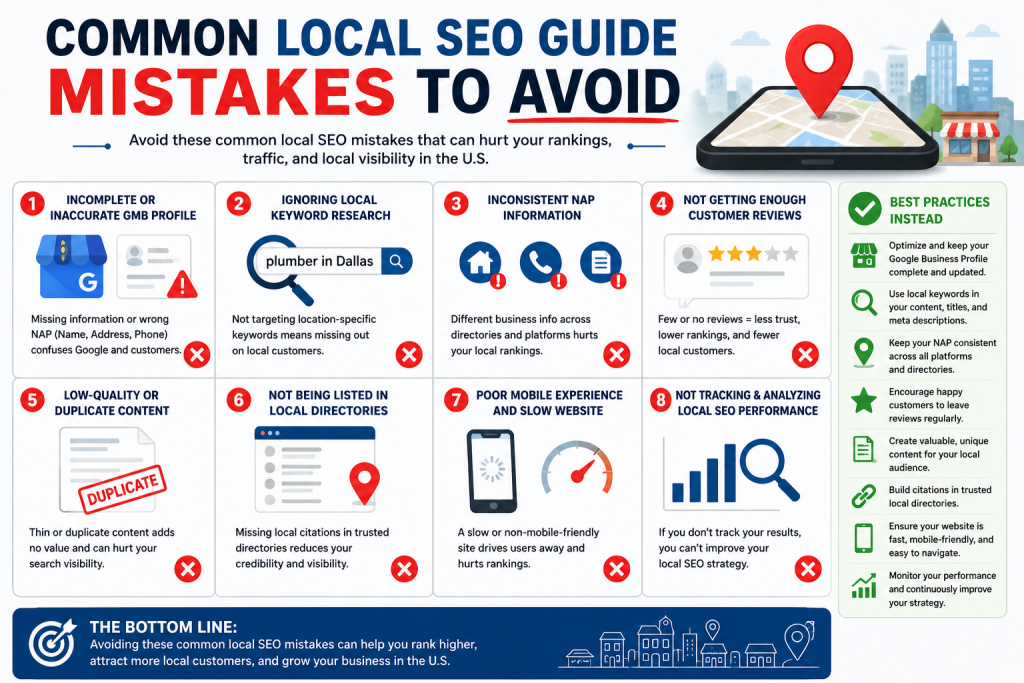
    Infographic highlighting common local SEO mistakes that can hurt U.S. business rankings, traffic, and local visibility, along with best practices for improving local search performance.

    Common Local SEO Guide Mistakes to Avoid

    Beginners often make these mistakes:

    • Using incorrect business information
    • Keyword stuffing city names
    • Buying fake reviews
    • Creating low-quality location pages
    • Ignoring mobile users
    • Building spammy backlinks
    • Neglecting their Google Business Profile
    • Expecting instant SEO results

    Local SEO is a long-term process. Consistency, relevance, useful content, and a strong customer experience are more sustainable than shortcuts.

    Final Thoughts

    This Local SEO Guide provides a practical starting point for U.S. businesses that want to improve their visibility in local search results in 2026.

    Start by optimizing your Google Business Profile, improving your website, targeting relevant local keywords, creating useful location-based content, earning genuine reviews, and building relationships with reputable local websites.

    The goal isn’t simply to rank higher. The goal is to help nearby customers discover your business when they are ready to take action.

    FAQs About Local SEO

    What is local SEO?

    Local SEO is the process of optimizing a business’s online presence to improve visibility for searches related to a specific geographic location.

    How long does local SEO take to work?

    Results vary based on competition, website authority, location, industry, and the quality of your SEO strategy. New businesses may need several months of consistent work to build meaningful visibility.

    Is local SEO important for small businesses?

    Yes. Local SEO can be especially valuable for small businesses that depend on customers within a particular city, region, or service area.

    Does Google Business Profile help with local SEO?

    A complete and accurate Google Business Profile is an important part of a local search strategy, particularly for businesses that interact with customers locally.

  • SEO for Beginners: Complete Guide to SEO in 2026

    SEO for Beginners: Complete Guide to SEO in 2026

    SEO for Beginners: Simple Guide to Search Engine Optimization 2026

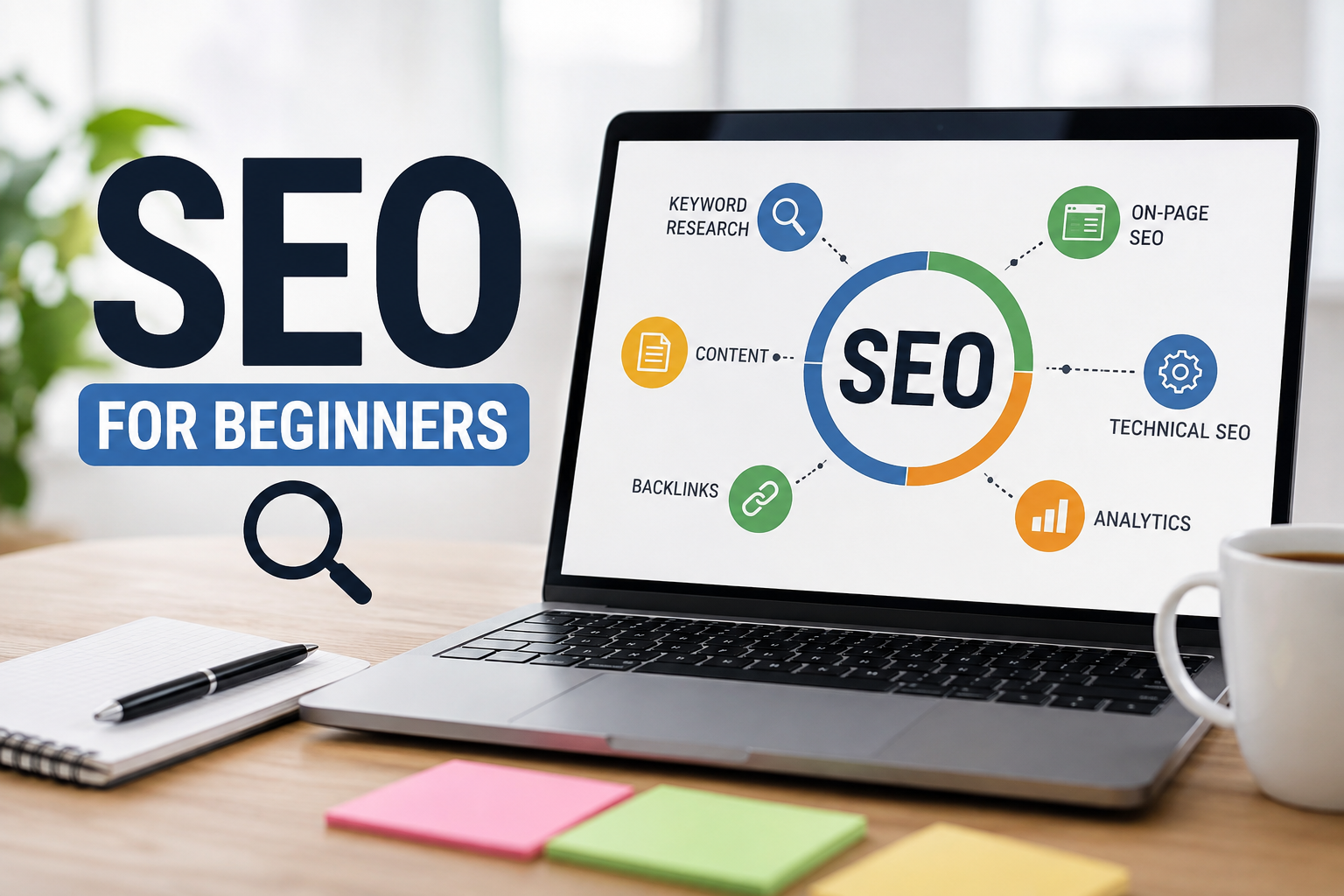
    If you are new to digital marketing, you have probably heard the term SEO, but you may not know where to start. SEO, or Search Engine Optimization, helps websites appear higher in search engine results when people search for information, products, or services.

    This SEO for Beginners guide explains the basics in simple language and shows U.S. website owners, bloggers, entrepreneurs, and small businesses how SEO can help increase organic traffic and online visibility in 2026.

    What Is SEO?

    SEO is the process of improving a website so search engines can better understand, index, and rank its content.

    For example, if you own a local plumbing business in Texas and someone searches for “plumber near me,” effective SEO can help your website appear in relevant search results.

    Unlike paid advertising, organic SEO traffic does not require you to pay for every click. However, SEO requires consistent effort, useful content, technical improvements, and patience.

    Why Is SEO Important in 2026?

    SEO for Beginners Search engines have become an essential way for people to find businesses, products, services, and answers online. For U.S. businesses, appearing prominently in search results can help attract potential customers who are already looking for what they offer.

    SEO can help you:

    • Increase organic website traffic
    • Improve online visibility
    • Reach potential customers
    • Build brand credibility
    • Generate leads
    • Increase online sales
    • Compete with larger businesses

    A strong SEO strategy focuses on helping users first SEO for Beginners rather than simply trying to manipulate search rankings.

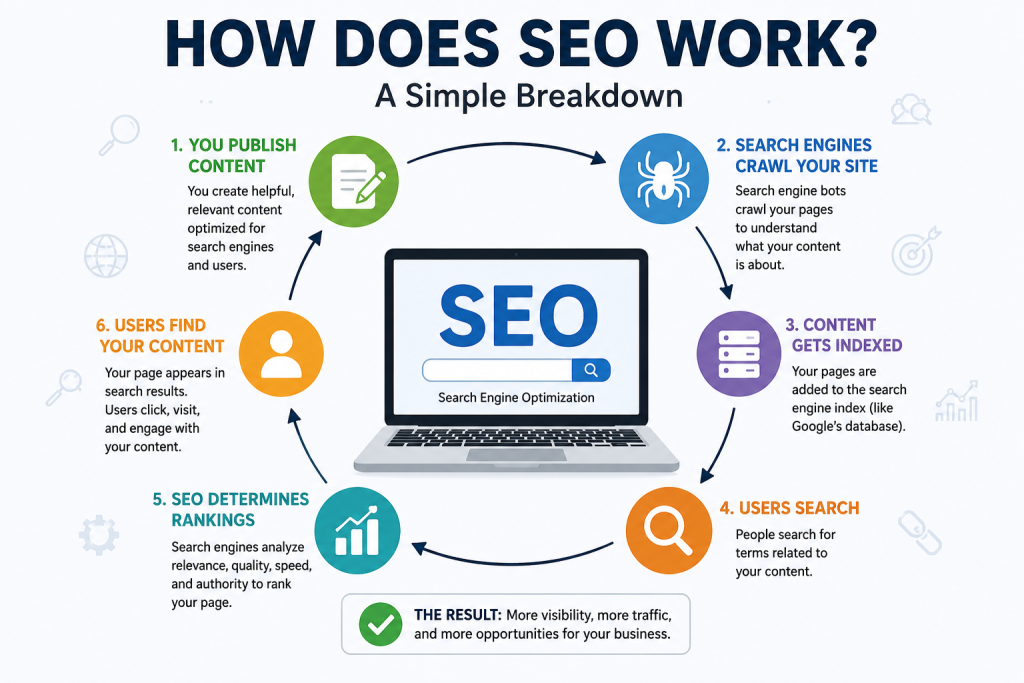
    An infographic explaining how SEO works, including content creation, crawling, indexing, search queries, rankings, and how users discover content through search engines.

    How Does SEO Work?

    Search engines use automated systems to discover, crawl, understand, and rank webpages.

    Although search algorithms are complex, beginners can focus on three major areas:

    1. On-Page SEO

    On-page SEO involves optimizing elements directly on your website.

    Important elements include:

    • SEO-friendly page titles
    • Clear headings
    • Helpful content
    • Relevant keywords
    • Descriptive URLs
    • Internal links
    • Image alt text
    • Easy-to-read formatting

    Your content should naturally answer the questions your target audience is searching for.

    2. Technical SEO

    Technical SEO focuses on making your website easier for search engines and visitors to use.

    Important technical factors include:

    • Mobile-friendly design
    • Fast page loading
    • Secure HTTPS
    • Proper website structure
    • Crawlable pages
    • Search engine indexing
    • Clean URLs
    • XML sitemaps

    You do not need to be a developer to understand basic technical SEO. Many website platforms and SEO tools can help identify common technical problems.

    3. Off-Page SEO

    Off-page SEO refers to activities that happen outside your website.

    One important example is earning backlinks from reputable and relevant websites. A backlink is a link from another website to yours.

    For local U.S. businesses, other useful signals can include consistent business information, reputable local listings, reviews, and mentions across relevant websites.

    Keyword Research for Beginners

    Keyword research is one of the most important parts of SEO for Beginners.

    A keyword is a word or phrase people type into a search engine.

    For example, someone searching for a local tree service might use keywords such as:

    • “tree removal service”
    • “tree trimming near me”
    • “emergency tree removal”
    • “tree removal cost”
    • “best tree service in Dallas”

    Instead of choosing keywords simply because they have high search volume, consider search intent. Ask yourself what the person actually wants to accomplish with the search.

    How to Create SEO-Friendly Content

    Great SEO content should be useful, original, accurate, and easy to understand.

    Start by choosing a specific topic and identifying the questions your audience wants answered. Use your primary keyword naturally in the title, introduction, headings, and relevant sections without overusing it.

    For example, if your focus keyword is SEO for Beginners, your article should genuinely teach beginners how SEO works rather than repeating the keyword unnecessarily.

    Use short paragraphs, descriptive headings, bullet points, examples, and clear explanations to improve readability.

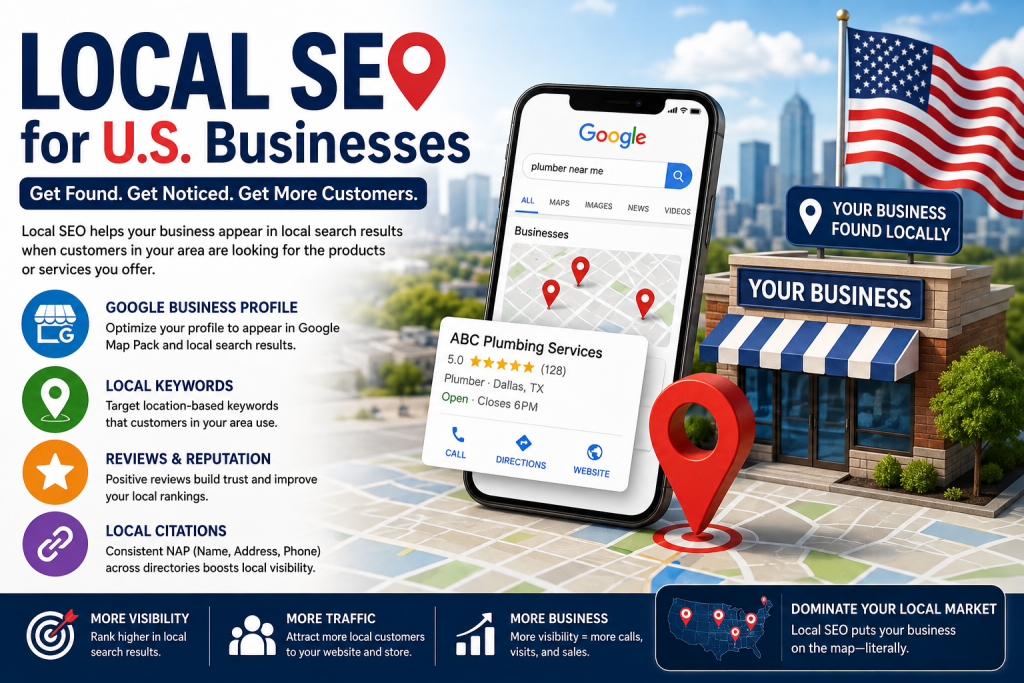
    A professional infographic showing how local SEO helps U.S. businesses improve Google visibility through local keywords, Google Business Profile, customer reviews, citations, and local search rankings.

    Local SEO for U.S. Businesses

    If you operate a business that serves a specific U.S. location, local SEO can be especially valuable.

    Optimize your website for relevant location-based searches, create and maintain your Google Business Profile, collect genuine customer reviews, and keep your business information accurate across important online directories.

    For example, a dentist in Chicago should create useful content around services and searches relevant to Chicago customers rather than trying to rank for every dental keyword nationwide.

    Common SEO Mistakes Beginners Should Avoid

    New website owners often make several SEO mistakes.

    Avoid:

    • Keyword stuffing
    • Copying content from other websites
    • Publishing very thin content
    • Buying low-quality backlinks
    • Ignoring mobile users
    • Using misleading titles
    • Creating content only for search engines
    • Expecting immediate results

    SEO is a long-term strategy. Results can take time, especially for a new website or competitive industry.

    Final Thoughts

    Learning SEO for Beginners does not have to be complicated. Start with the fundamentals: understand your audience, research relevant keywords, publish genuinely helpful content, improve your website experience, and build authority over time.

    For U.S. businesses and website owners in 2026, SEO remains an important way to build sustainable organic visibility. The best approach is to create content that satisfies real search intent while providing a fast, accessible, trustworthy experience for visitors.

    FAQs

    What is SEO for beginners?
    SEO for beginners is the process of learning how to optimize a website so search engines can understand its content and users can find it through organic search results.

    How long does SEO take to work?
    SEO results vary depending on competition, website authority, content quality, and technical factors. New websites may need several months of consistent optimization before seeing significant results.

    Is SEO still important in 2026?
    Yes. SEO remains useful for businesses, publishers, and website owners who want to attract relevant organic search traffic.

    What is the most important SEO factor for beginners?
    Start by creating genuinely useful content that matches search intent. Strong content combined with good technical SEO and a positive user experience provides a solid foundation

  • Complete Digital Marketing Guide (2026):  Best Practices for Success

    Complete Digital Marketing Guide (2026): Best Practices for Success

    Complete Digital Marketing Guide (2026)

    In today’s competitive online marketplace, having a Complete Digital Marketing Guide is essential for businesses that want to increase visibility, generate qualified leads, and boost revenue. Whether you’re a startup, small business, or established company in the United States, understanding digital marketing can help you stay ahead of your competitors.

    This Complete Digital Marketing Guide explains the most effective digital marketing strategies, channels, tools, and best practices that businesses should follow in 2026.


    What Is Digital Marketing?

    Digital marketing is the promotion of products or services through online channels such as search engines, websites, email, social media platforms, and paid advertising.

    Unlike traditional marketing, digital marketing allows businesses to:

    • Reach targeted audiences
    • Measure campaign performance
    • Improve return on investment (ROI)
    • Generate quality leads
    • Increase online sales

    A well-planned Complete Digital Marketing Guide helps businesses understand how these channels work together.


    Why Digital Marketing Matters in 2026

    Businesses across the US continue investing heavily in digital marketing because consumers spend more time online than ever before.

    Major benefits include:

    • Increased brand awareness
    • Better customer engagement
    • Higher website traffic
    • Cost-effective advertising
    • Improved customer retention
    • Measurable campaign performance

    Companies that follow a structured Complete Digital Marketing Guide are more likely to outperform competitors in today’s digital landscape.


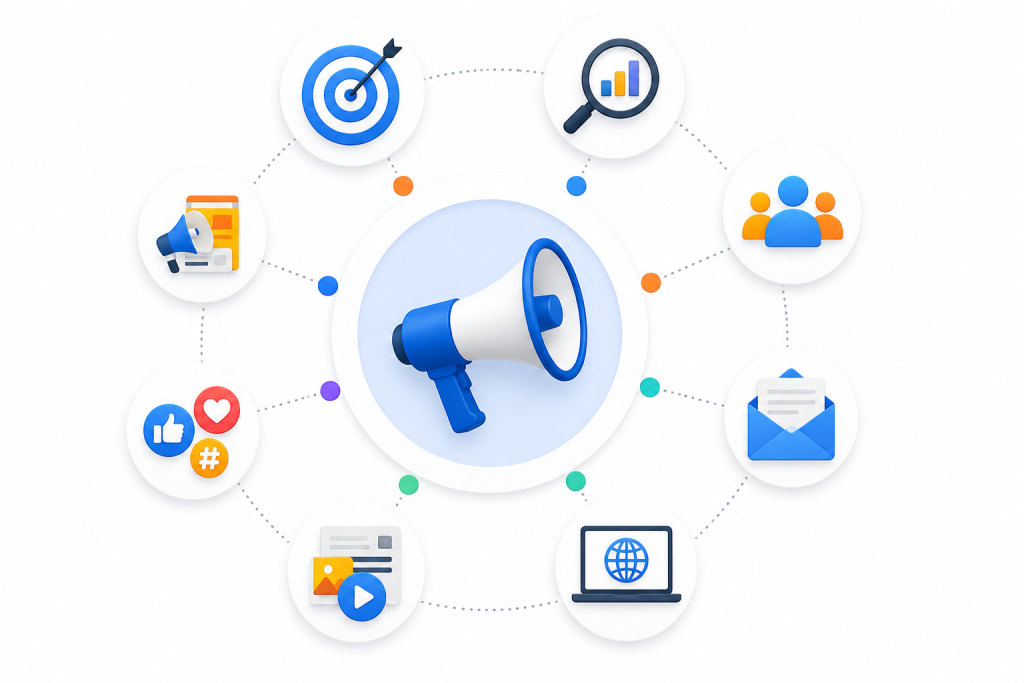
    A clean digital marketing infographic featuring visual icons representing essential components such as SEO, analytics, audience targeting, social media, email marketing, content marketing, advertising, and website strategy.

    Core Components of a Complete Digital Marketing Guide

    1. Search Engine Optimization (SEO)

    SEO helps websites rank higher on Google and other search engines.

    Important SEO practices include:

    • Keyword research
    • On-page optimization
    • Technical SEO
    • Internal linking
    • Quality backlinks
    • Mobile optimization
    • Fast website speed

    Good SEO creates long-term organic traffic without paying for every visitor.


    2. Content Marketing

    Content remains one of the strongest digital marketing strategies.

    Popular content types include:

    • Blog posts
    • Buying guides
    • Tutorials
    • Videos
    • Infographics
    • Case studies
    • FAQs

    Helpful, informative content builds trust while improving search engine rankings.


    3. Pay-Per-Click (PPC) Advertising

    PPC advertising allows businesses to appear instantly in search results.

    Popular PPC platforms include:

    • Google Ads
    • Microsoft Ads
    • YouTube Ads
    • Display Networks

    Benefits include:

    • Immediate traffic
    • Fast lead generation
    • Audience targeting
    • Budget control
    • Performance tracking

    4. Social Media Marketing

    Social media platforms help brands build communities and engage customers.

    Popular platforms for US businesses include:

    • Facebook
    • Instagram
    • LinkedIn
    • X
    • TikTok
    • Pinterest

    Consistent posting, audience engagement, and quality visuals improve brand recognition.


    5. Email Marketing

    Email marketing continues to deliver one of the highest returns on investment.

    Effective email campaigns include:

    • Welcome emails
    • Newsletters
    • Promotional campaigns
    • Product recommendations
    • Customer follow-ups

    Personalized emails often achieve better open and conversion rates.


    6. Local SEO

    Local SEO is especially valuable for businesses serving specific cities or regions.

    Best practices include:

    • Optimizing your Google Business Profile
    • Collecting customer reviews
    • Using location-based keywords
    • Building local citations
    • Creating city-specific landing pages

    Local SEO helps businesses attract nearby customers searching for services.


    Best Digital Marketing Strategies for US Businesses

    A successful strategy combines multiple channels instead of relying on just one.

    Some proven methods include:

    • Publishing helpful blog content weekly
    • Optimizing every webpage for SEO
    • Running targeted Google Ads campaigns
    • Posting regularly on social media
    • Building an email subscriber list
    • Tracking campaign performance with analytics
    • Updating old content regularly

    Following this Complete Digital Marketing Guide creates sustainable business growth over time.


    Essential Digital Marketing Tools

    Many marketers rely on professional tools to improve efficiency.

    Popular options include:

    • Google Analytics
    • Google Search Console
    • Google Ads
    • SEMrush
    • Ahrefs
    • Canva
    • Mailchimp
    • HubSpot

    These platforms help monitor traffic, optimize campaigns, and improve marketing performance.


    Common Digital Marketing Mistakes to Avoid

    Many businesses struggle because they make avoidable mistakes.

    Common errors include:

    • Ignoring SEO
    • Publishing low-quality content
    • Not tracking analytics
    • Targeting the wrong audience
    • Slow website performance
    • Poor mobile experience
    • Inconsistent branding
    • Neglecting email marketing

    Avoiding these mistakes increases long-term marketing success.


    Digital Marketing Trends for 2026

    The digital landscape continues evolving rapidly.

    Key trends include:

    • AI-powered content creation
    • Voice search optimization
    • Short-form video marketing
    • Personalized customer experiences
    • Marketing automation
    • Privacy-focused advertising
    • First-party data strategies
    • Interactive content

    Businesses that adapt to these trends will remain competitive.


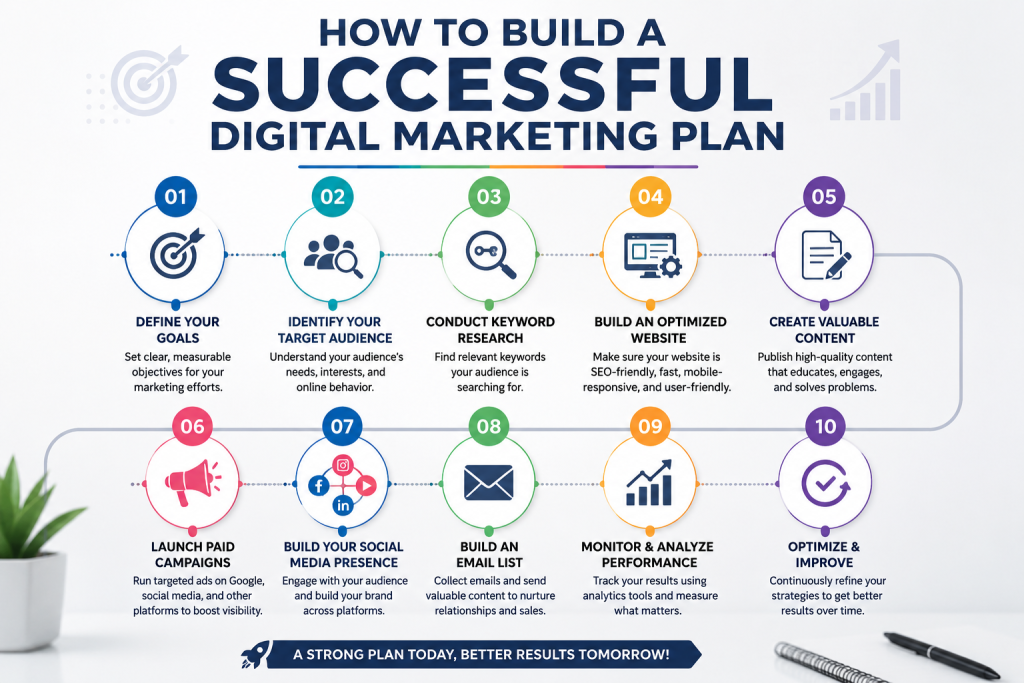
    How to Build a Successful Digital Marketing Plan in 2026 infographic showing goal setting, audience research, SEO, content marketing, PPC, social media, email marketing, analytics, and optimization for US businesses.

    How to Build a Successful Digital Marketing Plan

    A practical marketing plan should include:

    1. Define business goals.
    2. Identify your target audience.
    3. Conduct keyword research.
    4. Build an SEO-friendly website.
    5. Create valuable content.
    6. Launch paid advertising campaigns.
    7. Grow your social media presence.
    8. Build an email list.
    9. Monitor analytics.
    10. Continuously optimize campaigns.

    This structured approach makes the Complete Digital Marketing Guide easier to implement.


    Conclusion

    A Complete Digital Marketing Guide provides businesses with the knowledge needed to grow online, attract more customers, and increase revenue. By combining SEO, content marketing, PPC, social media, email marketing, and analytics, companies can create a strong online presence and stay competitive in 2026.

    Whether you’re launching a new business or expanding an existing one in the United States, investing in digital marketing is one of the smartest long-term growth strategies.


    Frequently Asked Questions (FAQs)

    What is the Complete Digital Marketing Guide?

    A Complete Digital Marketing Guide is a comprehensive resource that explains SEO, content marketing, PPC, social media, email marketing, and other online marketing strategies to help businesses grow.

    Why is digital marketing important in 2026?

    Digital marketing helps businesses reach more customers online, improve brand visibility, generate qualified leads, and increase sales using measurable marketing strategies.

    Which digital marketing strategy works best?

    The most effective approach combines SEO, quality content, paid advertising, email marketing, and social media to create consistent traffic and conversions.

    How long does SEO take to show results?

    Most SEO campaigns begin showing noticeable improvements within 3 to 6 months, depending on competition, website quality, and content strategy.

    Is digital marketing suitable for small businesses?

    Yes. Digital marketing allows small businesses to compete with larger companies by targeting specific audiences and managing advertising budgets efficiently.

  • AI Research Tools: Best Platforms & Latest Guide (2026)

    AI Research Tools: Best Platforms & Latest Guide (2026)

    AI Research Tools 2026: How to Choose the Right One

    Finding reliable information used to take hours of manual digging. Today, AI research tools compress that work into minutes. As a result, students, scientists, and businesses across the world are turning to these platforms to speed up discovery and cut through information overload.

    In 2026, this space is moving faster than ever. New agent-based systems, smarter literature reviewers, and cheaper large language models are reshaping how research actually gets done. This guide breaks down the latest updates and shows you exactly how to pick the right tool for your needs.

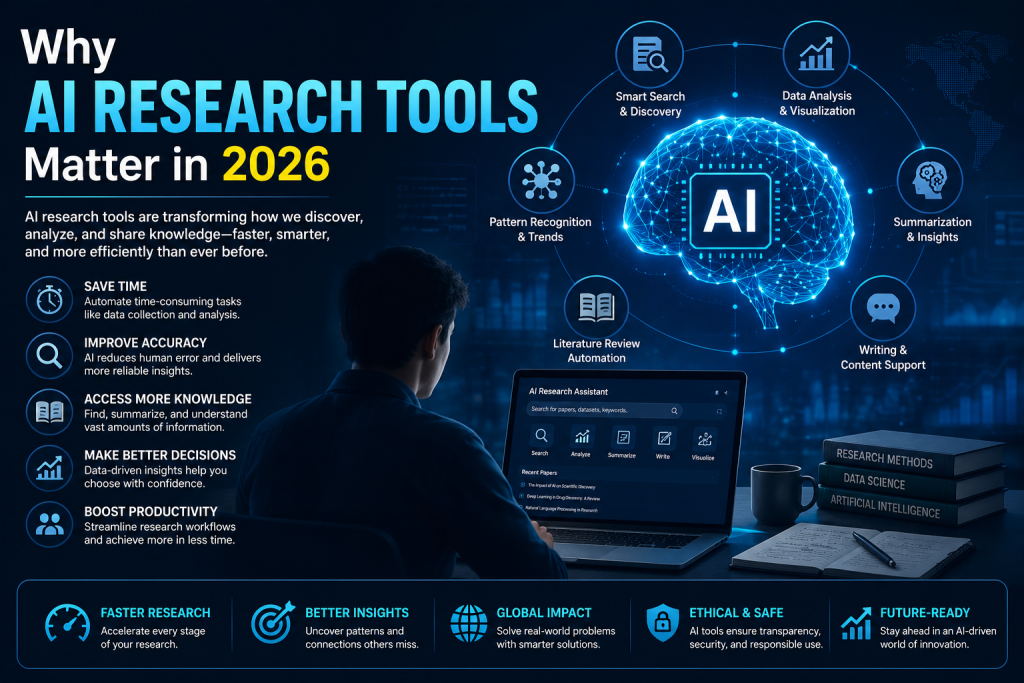
    A modern infographic showing the key benefits of AI research tools, including smart search, data analysis, literature review, summarization, productivity, and decision-making for researchers, students, and professionals.

    Why AI Research Tools Matter in 2026

    Research used to be a slow, linear process. However, modern AI research tools now handle multiple steps at once — searching, summarizing, and even proposing hypotheses.

    Here’s why this matters:

    • Speed: Tasks that took days now take hours.
    • Accessibility: Independent researchers get capabilities once limited to large labs.
    • Accuracy: Many tools now cite sources directly, reducing guesswork.
    • Cost: Inference costs have dropped sharply in 2026, making advanced tools more affordable for everyday users.

    Additionally, agent-based systems are moving beyond simple Q&A. For example, Google DeepMind’s Co-Scientist and FutureHouse’s Robin can now propose research hypotheses based on existing scientific literature, according to studies published in Nature this year. Meanwhile, DeepMind’s Empirical Research Assistance tool goes a step further by generating scientific software for researchers to use directly.

    Key Features to Consider

    Not all AI research tools are built the same. Therefore, before choosing one, check these factors carefully.

    Accuracy and Source Citation

    A good tool should link back to original sources. Consequently, this helps you verify claims instead of blindly trusting AI output.

    Context Window Size

    Larger context windows let a tool “remember” more of your project at once. Notably, several 2026 Ai update models now offer million-token context windows, which is useful for long documents or datasets.

    Integration and Workflow Fit

    Look for tools that connect with your existing apps, such as note-taking software or citation managers. This saves time and avoids copy-pasting between platforms.

    Cost Structure

    Some platforms now use credit-based pricing instead of flat subscriptions. As a result, it’s worth comparing your expected usage against the pricing model before committing.

    Types of AI Research Tools

    1. Literature Review Assistants

    These tools scan academic papers, summarize findings, and highlight gaps in existing research. They’re ideal for students and academics.

    2. Hypothesis-Generation Agents

    Newer AI research tools, like Co-Scientist, actively suggest research directions based on prior literature rather than just summarizing it.

    3. Data and Coding Assistants

    Tools such as Claude and specialized coding agents help researchers build simulations, analyze datasets, and generate scientific software.

    4. General-Purpose AI Assistants

    Broader models remain useful for quick fact-checking, drafting, and brainstorming across any field.

    How to Choose the Right Tool

    1. Define your task first. A literature review needs different features than data analysis.
    2. Test the free tier. Most platforms offer limited free access before you commit to a paid plan.
    3. Check citation reliability. Cross-check a few AI-generated citations manually.
    4. Compare pricing models. Credit-based systems can be cheaper or costlier depending on your usage pattern.

    Common Mistakes to Avoid

    • Trusting output blindly. Always verify facts and citations independently.
    • Ignoring data privacy. Read the tool’s data policy before uploading sensitive research.
    • Overpaying for unused features. Match the plan to your actual workload.
    • Sticking with one tool. Combining two or three specialized tools often works better than relying on a single all-in-one platform.
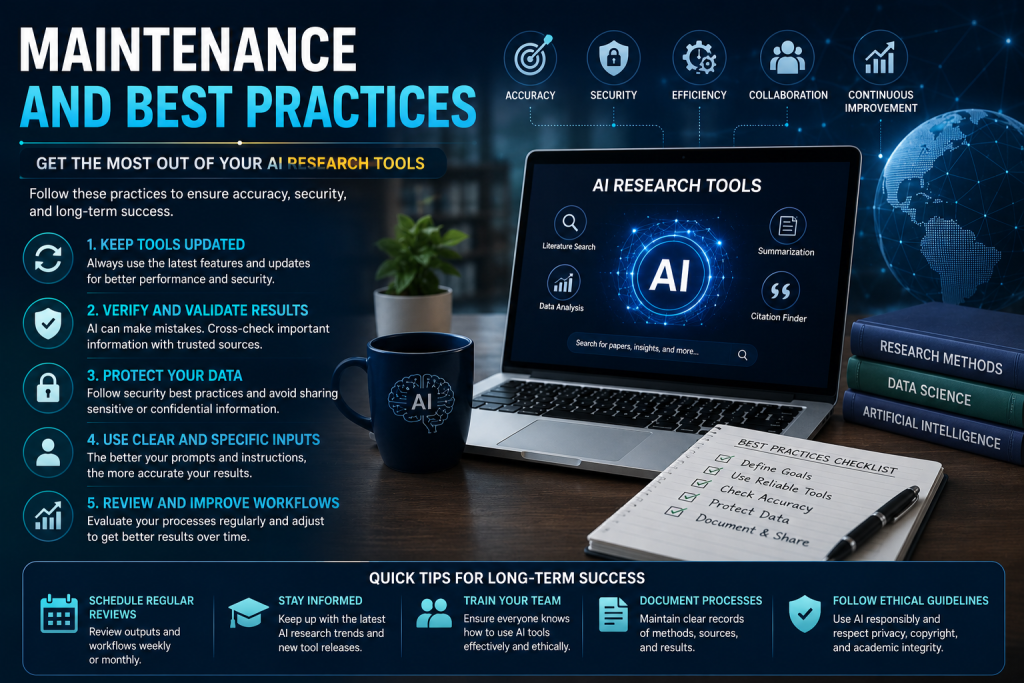
    A professional infographic illustrating maintenance tips and best practices for AI research tools, including software updates, result verification, data security, prompt optimization, workflow improvement, and ethical AI usage.

    Maintenance and Best Practices

    Keep your AI research tools updated, since providers frequently release model upgrades. Additionally, review your subscription every few months, as pricing and features change quickly in this fast-moving market. Finally, back up important findings outside the platform in case of service changes.

    Conclusion

    The landscape for AI research tools in 2026 is evolving quickly, with agent-based systems, larger context windows, and falling costs making advanced research more accessible than ever. Whether you’re a student, scientist, or business professional, choosing the right tool comes down to matching features to your specific workflow. Start by testing a free tier today, and let the right AI research tool save you hours of manual work.

    Frequently Asked Questions

    What are the best AI research tools in 2026?

    Some of the top options include Google DeepMind’s Co-Scientist, FutureHouse’s Robin, Claude, and various specialized literature-review assistants. However, the “best” tool depends on your specific task, such as literature review, data analysis, or hypothesis generation.

    Are AI research tools free to use?

    Many AI research tools offer a free tier with limited features. Additionally, most platforms now use credit-based pricing, so costs scale with how much you actually use.

    Can AI research tools replace human researchers?

    No. Developers of tools like Co-Scientist and Robin have stated their goal is to assist human researchers, not replace them. As a result, human judgment and verification remain essential.

    How accurate are AI research tools?

    Accuracy varies by tool and task. Therefore, it’s important to check citations and cross-verify AI-generated claims, especially for academic or professional work.

    Do AI research tools work for non-academic research?

    Yes. Beyond academia, businesses and independent professionals use for market research, competitive analysis, and general fact-finding.

  • AI Automation Tools in 2026:  Best AI Solutions

    AI Automation Tools in 2026: Best AI Solutions


    AI Automation Tools in 2026: The Best Solutions for Businesses

    Artificial Intelligence has transformed how businesses operate, and AI Automation Tools are now essential for improving productivity, reducing costs, and eliminating repetitive tasks. In 2026, companies across the United States are using AI-powered automation to streamline workflows, enhance customer experiences, and increase revenue.

    Whether you’re a small business owner, marketer, freelancer, or enterprise manager, the right AI Automation Tools can save hours of manual work every week.

    This guide covers the best AI automation software, their benefits, key features, and how to choose the right solution for your business.


    What Are AI Automation Tools?

    AI Automation Tools are software platforms that use artificial intelligence, machine learning, and automation technologies to perform repetitive tasks with minimal human intervention.

    Unlike traditional automation, AI can learn patterns, make decisions, analyze data, and continuously improve workflows.

    Businesses use these tools for:

    • Marketing automation
    • Customer support
    • Email management
    • Content creation
    • Data analysis
    • Sales automation
    • HR processes
    • Project management
    • Financial reporting

    Why AI Automation Tools Matter in 2026

    Businesses in the U.S. face increasing competition and rising labor costs. AI automation helps companies stay competitive by improving efficiency.

    Major benefits include:

    • Saves valuable time
    • Reduces operational costs
    • Minimizes human error
    • Improves customer service
    • Boosts employee productivity
    • Provides faster business insights
    • Automates repetitive workflows
    • Scales operations efficiently

    Organizations adopting AI Automation Tools can often accomplish more without significantly increasing headcount.


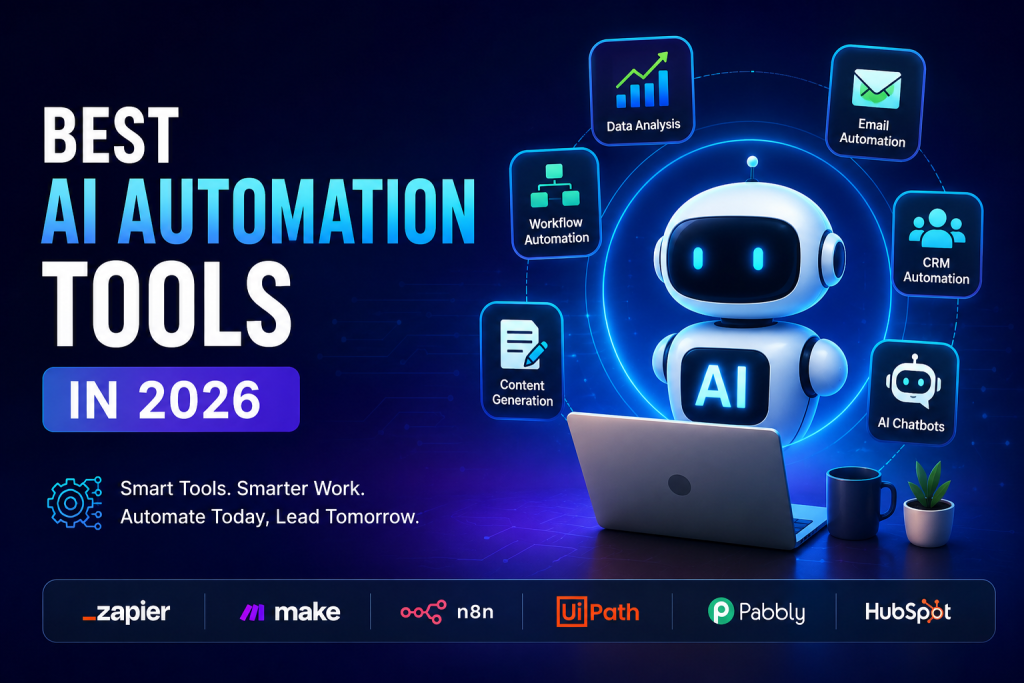
    Best AI Automation Tools in 2026 featuring an AI robot with workflow automation, CRM automation, email automation, data analysis, chatbots, and leading automation platforms like Zapier, Make, n8n, UiPath, Pabbly, and HubSpot.

    Best AI Automation Tools in 2026

    1. Zapier AI

    Zapier remains one of the most popular workflow automation platforms.

    Best for:

    • Connecting apps
    • Workflow automation
    • Small businesses
    • Marketing teams

    Popular automations include:

    • Lead generation
    • CRM updates
    • Email notifications
    • Google Sheets automation

    2. Make (formerly Integromat)

    Make provides advanced workflow automation with visual builders.

    Ideal for:

    • Developers
    • Agencies
    • Large workflow automation
    • API integrations

    Its flexible interface allows users to create powerful automation without extensive coding.


    3. Microsoft Power Automate

    Microsoft Power Automate is ideal for businesses already using Microsoft 365.

    Features include:

    • Document automation
    • Approval workflows
    • Desktop automation
    • AI Builder
    • Business process automation

    Large organizations across the U.S. rely on Power Automate for enterprise-level automation.


    4. Notion AI

    Notion AI combines productivity with intelligent automation.

    Use cases include:

    • Meeting summaries
    • Task management
    • Documentation
    • Content drafting
    • Project planning

    It helps teams organize knowledge while reducing manual work.


    5. ChatGPT

    ChatGPT has become one of the most versatile AI Automation Tools available.

    Businesses use it for:

    • Customer support
    • Content writing
    • Email drafting
    • Coding assistance
    • Research
    • Internal documentation

    Its integration with various business platforms makes it a valuable automation assistant.


    6. UiPath

    UiPath specializes in Robotic Process Automation (RPA).

    Perfect for:

    • Large enterprises
    • Banking
    • Healthcare
    • Insurance
    • Manufacturing

    It automates repetitive business processes that traditionally required human employees.


    Key Features to Look for in AI Automation Tools

    Before choosing a platform, consider these important features:

    • Easy workflow builder
    • AI-powered decision making
    • Third-party integrations
    • Security and compliance
    • Cloud-based access
    • Custom automation rules
    • Analytics dashboard
    • Scalability
    • API support

    Selecting software with these capabilities ensures long-term value for your business.


    Industries Using AI Automation Tools

    Almost every industry benefits from AI automation.

    Healthcare

    • Appointment scheduling
    • Medical documentation
    • Patient communication

    Marketing

    • Campaign automation
    • Social media scheduling
    • Content generation
    • Lead nurturing

    E-commerce

    • Order processing
    • Inventory updates
    • Customer support
    • Product recommendations

    Finance

    • Invoice automation
    • Expense tracking
    • Fraud detection
    • Financial reporting

    Human Resources

    • Resume screening
    • Employee onboarding
    • Payroll assistance
    • Interview scheduling

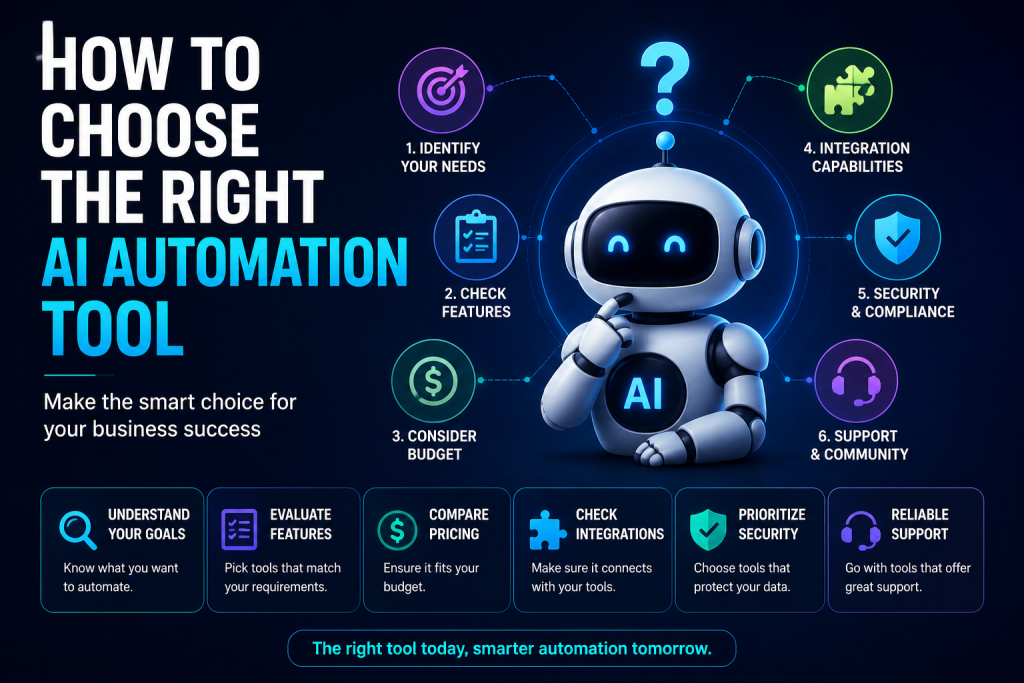
    How to Choose the Right AI Automation Tool infographic featuring an AI assistant with key decision factors including business needs, features, budget, integrations, security, and customer support for selecting the best AI automation software.

    How to Choose the Right AI Automation Tool

    The best solution depends on your business goals.

    Ask yourself:

    • What tasks consume the most time?
    • Which software do you already use?
    • Do you need no-code automation?
    • How many employees will use it?
    • Does it fit your budget?
    • Can it scale as your business grows?

    Testing free trials before purchasing is always a smart approach.


    Future of AI Automation

    The future of AI Automation Tools looks incredibly promising. By 2026 and beyond, businesses can expect:

    • Smarter AI agents
    • Autonomous workflows
    • Predictive automation
    • Voice-controlled automation
    • Hyper-personalized customer experiences
    • Advanced business intelligence

    Companies that invest in AI automation today will be better positioned to compete in an increasingly digital marketplace.


    Conclusion

    AI Automation Tools have become essential for businesses aiming to improve efficiency, reduce costs, and scale operations. From startups to large enterprises, AI-powered automation is helping organizations complete tasks faster while allowing employees to focus on higher-value work.

    Whether you choose Zapier, Make, Microsoft Power Automate, Notion AI, ChatGPT, or UiPath, the right automation platform can transform the way you work. As AI technology continues to evolve throughout 2026, adopting automation will no longer be a competitive advantage—it will be a business necessity.


    Frequently Asked Questions (FAQs)

    What are AI Automation Tools?

    AI Automation Tools are software solutions that use artificial intelligence to automate repetitive tasks, improve workflows, and increase productivity.

    Which AI automation tool is best for small businesses?

    Zapier, ChatGPT, and Notion AI are among the best options for small businesses because they are user-friendly, affordable, and highly scalable.

    Can AI Automation Tools replace employees?

    AI is designed to automate repetitive tasks rather than replace employees. It allows teams to focus on strategic, creative, and customer-facing work.

    Are AI Automation Tools expensive?

    Many platforms offer free plans or affordable monthly subscriptions, making AI automation accessible to businesses of all sizes.
    Is AI automation secure?

    Most leading AI automation platforms provide enterprise-grade security, encryption, and compliance features. Always review a provider’s security policies before implementation.

  • Best AI Chrome Extensions in 2026 to Work Smarter and Save Time

    Best AI Chrome Extensions in 2026 to Work Smarter and Save Time

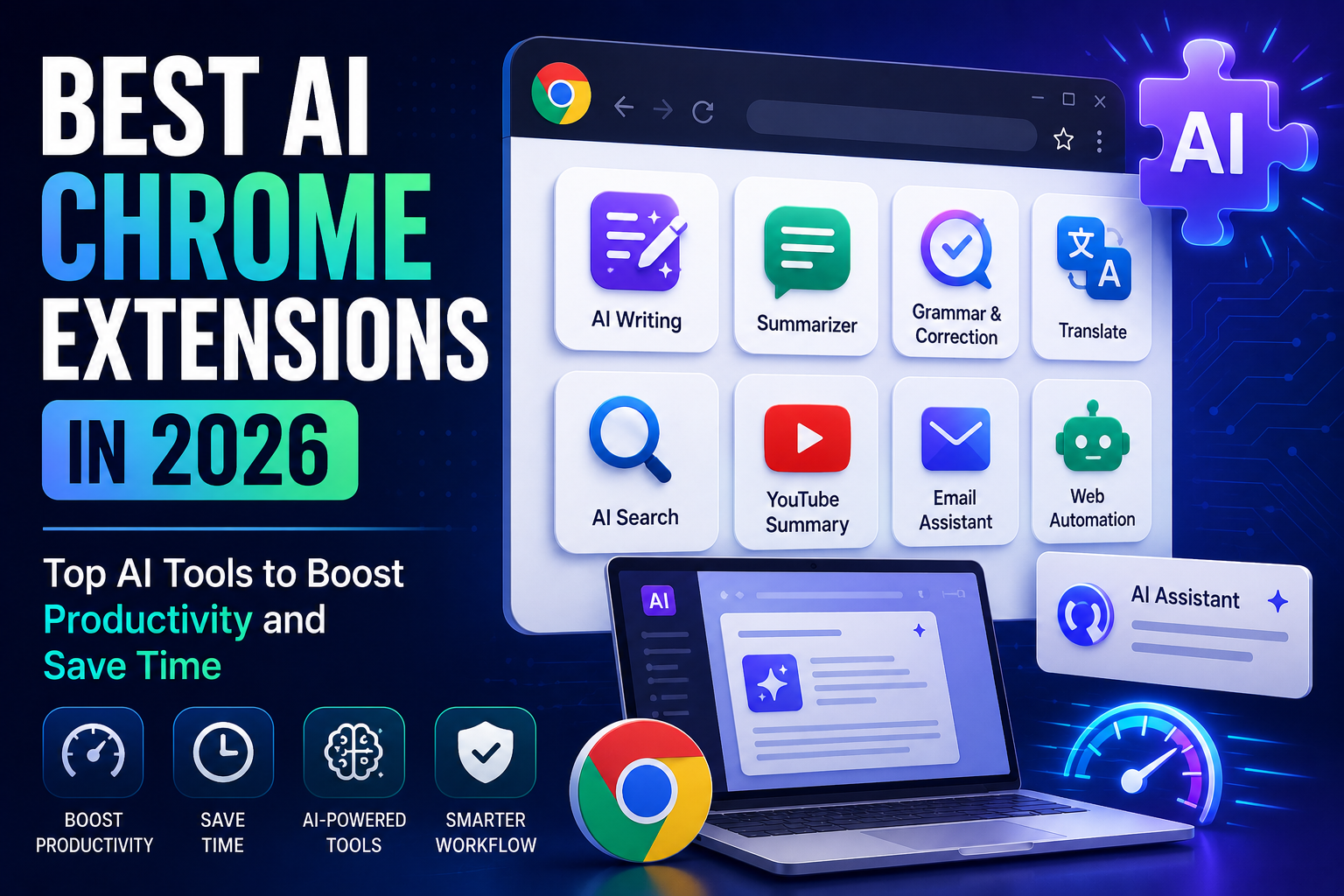
    Best AI Chrome Extensions in 2026: Top AI Tools to Boost Productivity

    The Best AI Chrome Extensions are changing the way people browse the web, write content, conduct research, manage emails, and improve productivity. In 2026, artificial intelligence has become an essential part of daily workflows for students, professionals, marketers, developers, and business owners across the United States.

    Whether you’re looking to write emails faster, summarize web pages, generate content, improve grammar, or automate repetitive tasks, the Best AI Chrome Extensions can help you work smarter without leaving your browser.

    In this guide, we’ll explore the Best AI Chrome Extensions available in 2026, their features, benefits, and how to choose the right extension for your needs.


    What Are AI Chrome Extensions?

    AI Chrome extensions are browser add-ons powered by artificial intelligence that enhance your browsing experience. These tools integrate directly into Google Chrome and help automate tasks such as writing, translation, note-taking, summarization, coding assistance, grammar correction, and online research.

    The Best AI Chrome Extensions allow users to complete everyday tasks more efficiently while improving productivity and accuracy.


    Why Use AI Chrome Extensions in 2026?

    Artificial intelligence is making browser-based work faster than ever. The Best AI Chrome Extensions offer several advantages, including:

    • Save time on repetitive tasks
    • Improve writing quality
    • Automate research
    • Summarize lengthy articles
    • Generate professional emails
    • Boost workplace productivity
    • Improve online collaboration
    • Enhance learning and research

    These extensions are ideal for anyone who spends a significant amount of time working in a web browser.


    Best AI Chrome Extensions in 2026

    1. ChatGPT for Chrome

    ChatGPT browser extensions allow users to generate content, answer questions, summarize pages, and brainstorm ideas directly within Chrome.

    Best For:

    • Writing
    • Research
    • Email drafting
    • Content creation

    2. Grammarly

    Grammarly remains one of the Best AI Chrome Extensions for improving grammar, spelling, clarity, and tone across emails, documents, and social media.

    Key Features:

    • Grammar checking
    • AI writing suggestions
    • Tone detection
    • Plagiarism assistance

    3. Merlin AI

    Merlin AI brings AI assistance to Google Search, Gmail, LinkedIn, YouTube, and many other websites.

    Popular features include:

    • AI chat
    • Content generation
    • Quick replies
    • Research assistance

    4. Compose AI

    Compose AI helps users write emails, documents, and messages faster using AI-powered autocomplete and sentence generation.

    Ideal for professionals who write frequently.


    5. Monica AI

    Monica AI works as an all-in-one AI assistant capable of translating text, summarizing webpages, generating content, and answering questions without leaving the browser.


    6. Sider AI

    Sider AI integrates advanced AI models into Chrome, allowing users to summarize articles, explain complex topics, and generate text while browsing.


    7. Perplexity AI Extension

    Perplexity AI provides quick, accurate answers with cited sources, making it an excellent research assistant for students and professionals.


    8. LanguageTool

    LanguageTool offers AI-powered grammar, spelling, and style improvements for multiple languages, making it useful for international communication.


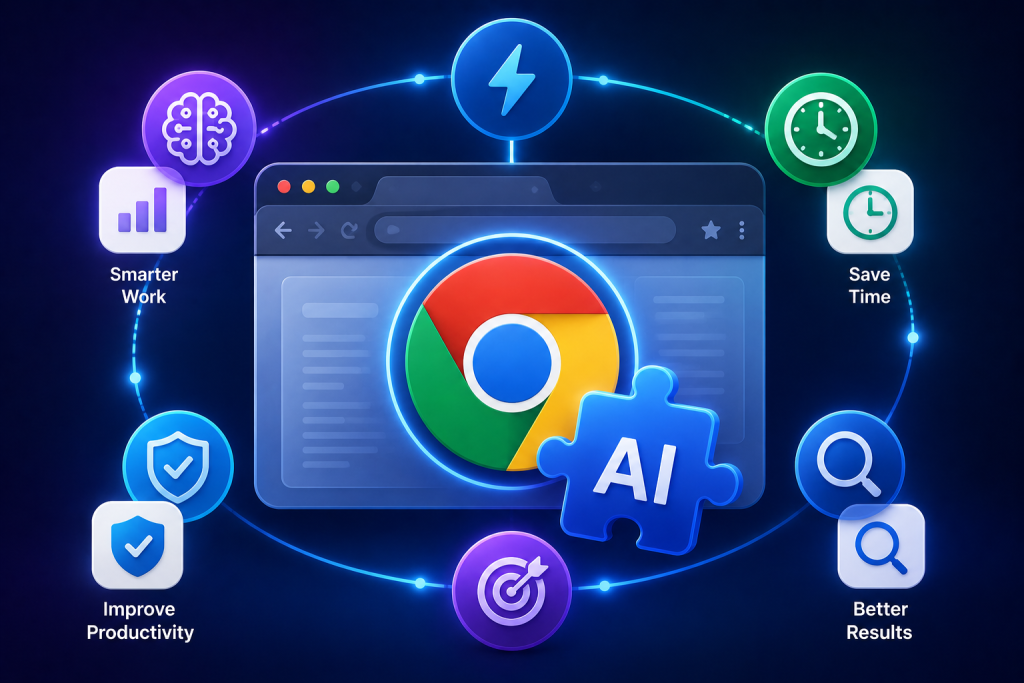
    Illustration showing the benefits of using the best AI Chrome extensions with browser interface, AI extension icon, productivity tools, automation, time-saving, and smart workflow features.

    Benefits of Using the Best AI Chrome Extensions

    The Best AI Chrome Extensions offer several benefits for individuals and businesses.

    Increase Productivity

    AI automates repetitive tasks, allowing users to focus on higher-value work.

    Improve Writing

    Extensions provide grammar correction, style suggestions, and AI-generated content for professional communication.

    Faster Research

    AI can summarize long articles, highlight important information, and answer questions instantly.

    Better Time Management

    Automation reduces the time spent on writing, editing, searching, and organizing information.

    Enhanced Accuracy

    AI-powered suggestions reduce writing errors and improve the quality of online communication.


    How to Choose the Best AI Chrome Extensions

    Before installing an extension, consider the following factors:

    Features

    Choose extensions that match your workflow, whether it’s writing, coding, research, or productivity.

    Security

    Only install extensions from trusted developers with positive user reviews.

    Ease of Use

    Look for tools with intuitive interfaces that integrate seamlessly into Chrome.

    Compatibility

    Ensure the extension works with your favorite websites and productivity tools.

    Pricing

    Many AI Chrome extensions offer free versions with optional premium upgrades.


    Who Should Use AI Chrome Extensions?

    The Best AI Chrome Extensions are useful for:

    • Students
    • Teachers
    • Bloggers
    • Content creators
    • Copywriters
    • Digital marketers
    • Small business owners
    • Software developers
    • Researchers
    • Customer support teams

    Anyone who works online can benefit from AI-powered browser tools.


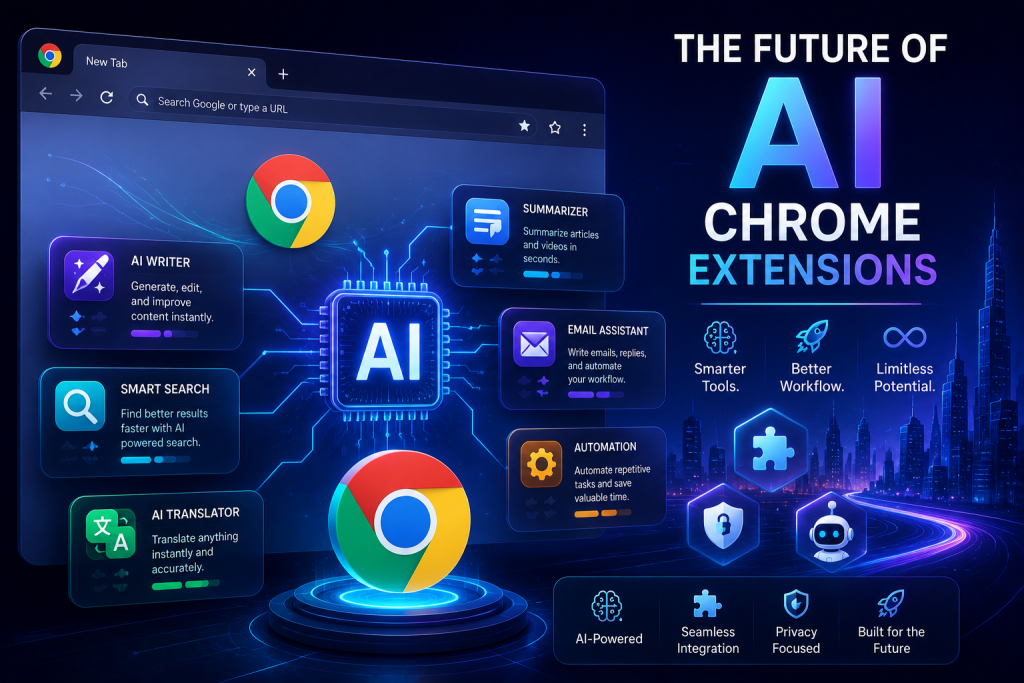
    Futuristic illustration of AI Chrome extensions featuring a modern browser interface, glowing AI processor, smart automation tools, writing assistant, search, translation, productivity icons, and a cyber-tech city background representing the future of AI-powered browser extensions.

    Future of AI Chrome Extensions

    The future of the Best AI Chrome Extensions is promising as AI technology continues to evolve. Upcoming innovations may include:

    • More personalized AI assistance
    • Better voice interaction
    • Advanced browser automation
    • Smarter research capabilities
    • Improved multilingual support
    • Enhanced cybersecurity features
    • Real-time collaboration tools
    • AI-powered workflow automation

    As AI becomes more integrated into web browsers, users can expect even greater productivity gains.


    Tips for Getting the Most Out of AI Chrome Extensions

    To maximize your experience:

    • Install only trusted extensions.
    • Keep extensions updated.
    • Review AI-generated content before publishing.
    • Use multiple AI tools for different tasks.
    • Remove unused extensions to improve browser performance.
    • Protect sensitive information when using AI tools.

    Conclusion

    The Best AI Chrome Extensions have become indispensable tools for professionals, students, and businesses in 2026. Whether you need help with writing, research, productivity, or communication, these AI-powered browser extensions can save time and improve efficiency.

    By choosing the right extension for your workflow, you can streamline daily tasks, enhance productivity, and get more done directly from your Chrome browser. As AI technology advances, browser extensions will continue to play a vital role in the future of work and online collaboration.


    Frequently Asked Questions (FAQs)

    What are AI Chrome Extensions?

    AI Chrome extensions are browser add-ons that use artificial intelligence to help users write, research, summarize, translate, and automate tasks directly in Google Chrome.

    Which are the Best AI Chrome Extensions in 2026?

    Some of the Best AI Chrome Extensions include Grammarly, Merlin AI, Monica AI, Compose AI, Sider AI, Perplexity AI, ChatGPT for Chrome, and LanguageTool.

    Are AI Chrome Extensions free?

    Many AI Chrome extensions offer free plans with limited features, while premium subscriptions unlock advanced AI capabilities.

    Are AI Chrome Extensions safe?

    Most extensions from trusted developers are safe. Always install extensions from the Chrome Web Store, review permissions, and keep them updated.

    Can AI Chrome Extensions improve productivity?

    Yes. The Best AI Chrome Extensions help automate repetitive tasks, improve writing quality, speed up research, and increase overall productivity, making them valuable tools for both personal and professional use.