Tag: Lead Generation

  • Content Marketing in 2026: Complete Guide for US Businesses

    Content Marketing in 2026: Complete Guide for US Businesses

    Content Marketing in 2026: Ultimate Guide for Businesses

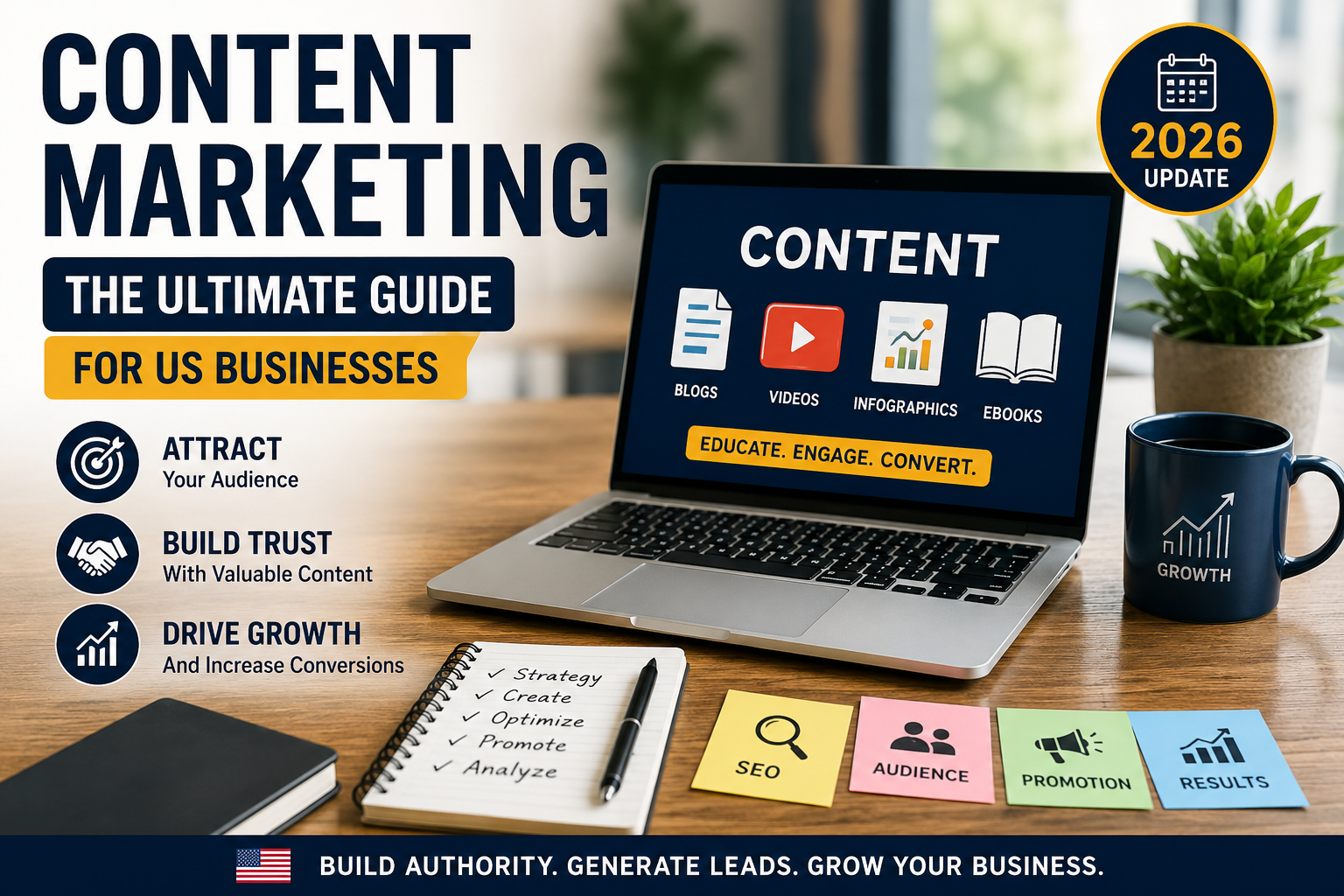
    In today’s digital-first marketplace, Content Marketing remains one of the most effective ways for businesses to attract customers and grow online. A strong content marketing strategy helps brands connect with their audience, build trust, and generate consistent leads without relying entirely on paid advertising.

    Consumers in the United States increasingly research products, services, and companies before making purchasing decisions. Businesses that publish valuable and informative content are more likely to gain visibility, credibility, and long-term customer loyalty.

    Why Content Marketing Matters for US Businesses

    Content Marketing helps companies educate potential customers while improving their online presence. A well-planned content marketing strategy allows businesses to answer customer questions, address pain points, and guide prospects through the buying journey.

    Whether you operate a local business, eCommerce store, SaaS company, or professional service firm, creating useful content can strengthen your brand authority and improve search engine rankings. Search engines reward websites that consistently provide relevant and helpful information to users.

    Benefits of Content Marketing

    The value of Content Marketing goes beyond website traffic. When executed correctly, it can deliver measurable business results.

    Key benefits include:

    • Increased organic search visibility
    • Higher website traffic
    • Better brand recognition
    • Improved customer trust
    • More qualified leads
    • Stronger customer engagement
    • Higher conversion opportunities

    One of the biggest advantages of Content Marketing is its ability to create long-term value. Unlike paid advertising campaigns that stop generating traffic when spending ends, quality content can continue attracting visitors and leads for months or even years.

    Building an Effective Content Marketing Strategy

    A successful strategy starts with understanding your audience. Before creating content, businesses should identify customer needs, common questions, and search behavior.

    Content Marketing performs best when every piece of content serves a specific purpose. Companies should focus on producing educational, engaging, and relevant resources that solve real problems for their audience.

    Steps to build a successful plan include:

    1. Define business goals.
    2. Identify target audiences.
    3. Conduct keyword research.
    4. Create a content calendar.
    5. Publish valuable content consistently.
    6. Promote content across multiple channels.
    7. Analyze results and improve performance.

    A clear content marketing strategy ensures that every article, video, infographic, or guide supports broader business objectives.

    How Content Marketing Supports SEO

    Search engine optimization and Content Marketing work together to improve online visibility. Without valuable content, it becomes difficult to rank for competitive keywords and attract organic traffic.

    A strong content strategy should focus on search intent, keyword relevance, content quality, and user experience. Search engines increasingly prioritize content that demonstrates expertise, authority, and trustworthiness.

    Businesses should optimize content by:

    • Using relevant keywords naturally
    • Writing compelling headlines
    • Creating informative content
    • Improving page loading speed
    • Optimizing for mobile users
    • Adding internal links
    • Updating older content regularly

    These practices help improve rankings while providing a better experience for visitors.
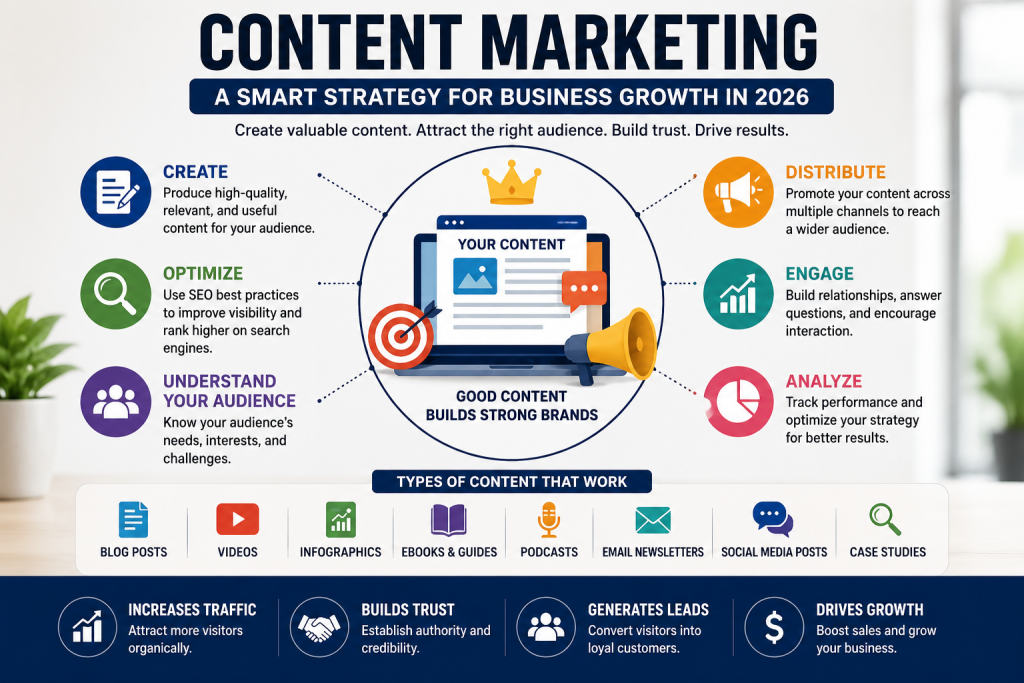
    Content marketing strategy infographic showing content creation, SEO optimization, audience engagement, content distribution, and business growth in 2026

    Content Marketing Trends for 2026

    As digital marketing evolves, Content Marketing continues to adapt to changing consumer expectations and search engine algorithms.

    A modern marketing strategy should include a mix of formats such as:

    • Blog articles
    • Videos
    • Case studies
    • Podcasts
    • Email newsletters
    • Interactive content
    • Industry reports

    Businesses that diversify content formats can reach broader audiences while increasing engagement across multiple channels. In 2026, brands that prioritize helpful, user-focused content are expected to achieve stronger organic growth.

    Measuring Content Marketing Success

    Tracking performance is essential for improving Content results over time. Businesses should regularly monitor key metrics to understand what content generates the greatest impact.

    Important metrics include:

    • Organic traffic
    • Keyword rankings
    • Click-through rates
    • Lead generation
    • Conversion rates
    • Time on page
    • Engagement metrics

    By evaluating these indicators, companies can identify opportunities for improvement and make data-driven decisions that support long-term growth.

    Common Mistakes to Avoid

    Many organizations invest in Marketing but fail to achieve desired results because they overlook critical fundamentals.

    Common mistakes include:

    • Publishing inconsistent content
    • Ignoring audience intent
    • Focusing only on promotional messaging
    • Neglecting SEO optimization
    • Failing to track performance
    • Producing low-quality content

    Avoiding these issues can improve effectiveness and increase return on investment.

    Conclusion

    Marketing remains a powerful growth engine for businesses across the United States. Companies that implement a strong content marketing strategy can attract qualified traffic, build authority, strengthen customer relationships, and generate sustainable results.

    As competition increases in 2026, businesses that focus on creating valuable, relevant, and user-focused content will be positioned for long-term success. Investing in Marketing today can help establish a stronger digital presence and create lasting competitive advantages for the future.


  • Email Marketing Guide: How to Build a Winning Strategy in 2026

    Email Marketing Guide: How to Build a Winning Strategy in 2026

    Email Marketing Guide:

    An effective Email Marketing Guide helps U.S. businesses turn subscribers into customers, increase sales, and build lasting relationships. Email lets brands communicate directly with people who have already shown interest in their products or services.

    For U.S. small businesses, ecommerce stores, SaaS companies, agencies, and local businesses, email can support lead generation and customer retention.

    Why Email Marketing Matters in 2026

    In 2026, consumers receive countless digital messages, making relevance more important than volume. A strong Email Marketing Guide focuses on delivering useful content to the right audience at the right time.

    Email marketing can help businesses:

    • Generate website traffic and sales
    • Nurture leads through the buying journey
    • Promote products and services
    • Improve customer retention
    • Build brand awareness
    • Share educational content
    • Re-engage inactive subscribers

    Email gives businesses direct control over subscriber communication, making it an important part of a U.S. digital marketing strategy.

    Professional email marketing illustration showing subscriber growth, newsletter signup, audience engagement, lead generation, and email list building strategies.

    Build a High-Quality Email List

    The foundation of an effective Email Marketing Guide is a permission-based email list. Use this Email Marketing Guide to build campaigns around customer needs. Avoid purchasing email databases. Instead, encourage people to subscribe voluntarily.

    Useful list-building methods include:

    • Website signup forms
    • Free guides and downloadable resources
    • Coupons and special offers
    • Webinar registrations
    • Checkout opt-ins
    • Blog newsletter forms
    • Lead-generation landing pages

    Tell subscribers what they will receive and how often you will email them.

    Choose the Right Email Marketing Platform

    Your Email Marketing Guide should include selecting software that fits your business goals, audience size, and budget. Email platforms can provide automation, segmentation, templates, analytics, and subscriber management.

    Before choosing a platform, compare automation, deliverability, analytics, integrations, pricing, and customer support.

    A small U.S. business may need a simple newsletter tool, while a growing ecommerce brand may need advanced automation.

    Create Valuable Email Content

    A successful Email Marketing Guide is not about sending more emails. It is about sending better emails. Use clear subject lines, concise copy, and a strong call to action.

    Useful content includes product announcements, educational tips, promotions, company updates, customer stories, recommendations, and event invitations.

    Keep emails mobile-friendly because many subscribers read messages on smartphones.

    Use Segmentation and Personalization

    One of the most important principles in an Email Marketing Guide is audience segmentation. Sending identical messages to everyone can reduce engagement.

    Segment subscribers by:

    • Location
    • Purchase history
    • Website behavior
    • Interests
    • Customer type
    • Email engagement

    For example, a U.S. retailer can send different offers to first-time buyers, repeat customers, and inactive subscribers. Personalized messages can make campaigns more relevant and useful.

    Automate Your Email Campaigns

    Email automation is another key part of an Email Marketing Guide because it lets businesses communicate consistently without manually sending every message.

    Common automated campaigns include:

    • Welcome emails
    • Abandoned cart reminders
    • Lead-nurturing sequences
    • Post-purchase follow-ups
    • Review requests
    • Re-engagement campaigns

    Each automated email should have a clear purpose and match the customer journey.

    Follow U.S. Email Marketing Rules

    A responsible Email Marketing Guide should address compliance. This Email Marketing Guide also keeps compliance in the planning process. U.S. businesses should follow the CAN-SPAM Act requirements when sending commercial emails.

    Avoid deceptive subject lines, identify commercial messages appropriately, provide a valid physical postal address, and make it easy for recipients to opt out. Unsubscribe requests should be handled promptly.

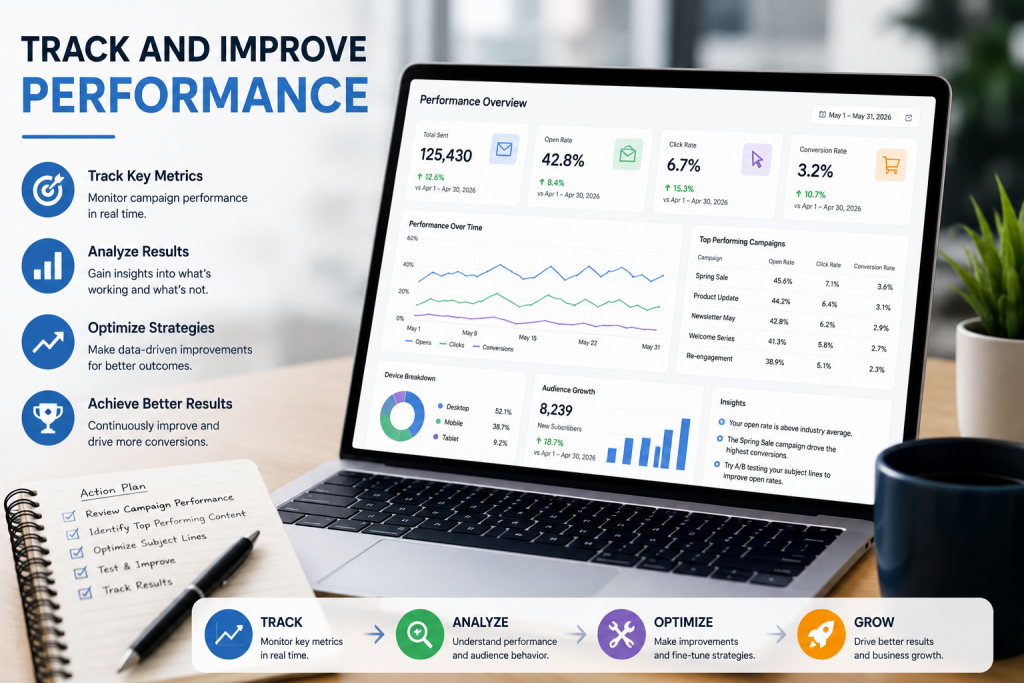
    Email marketing performance dashboard showing key metrics such as open rate, click rate, conversions, audience growth, campaign performance, and optimization insights.

    Track and Improve Performance

    The best Email Marketing Guide includes regular performance measurement. Track metrics such as open rate, click-through rate, conversion rate, unsubscribe rate, bounce rate, and revenue generated from campaigns.

    Test subject lines, offers, content, send times, and calls to action to discover what works best.

    Avoid Common Email Marketing Mistakes

    A practical Email Marketing Guide can help you avoid problems such as buying email lists, sending too frequently, misleading subject lines, poor mobile design, overly long emails, and inactive subscribers.

    Focus on permission, relevance, consistency, and value. A smaller list of engaged subscribers can be more valuable than a large list of uninterested contacts.

    Final Thoughts

    This Email Marketing Guide is built around one simple goal: provide useful information that encourages subscribers to take meaningful action. In 2026, U.S. businesses can use email to attract leads, nurture prospects, strengthen customer loyalty, and drive measurable revenue.

    Start with a permission-based list, create valuable content, segment your audience, automate communication, follow U.S. requirements, and measure results. Consistent testing can make email marketing a reliable long-term strategy.