
Content Marketing in 2026: Ultimate Guide for Businesses
In today’s digital-first marketplace, Content Marketing remains one of the most effective ways for businesses to attract customers and grow online. A strong content marketing strategy helps brands connect with their audience, build trust, and generate consistent leads without relying entirely on paid advertising.
Consumers in the United States increasingly research products, services, and companies before making purchasing decisions. Businesses that publish valuable and informative content are more likely to gain visibility, credibility, and long-term customer loyalty.
Why Content Marketing Matters for US Businesses
Content Marketing helps companies educate potential customers while improving their online presence. A well-planned content marketing strategy allows businesses to answer customer questions, address pain points, and guide prospects through the buying journey.
Whether you operate a local business, eCommerce store, SaaS company, or professional service firm, creating useful content can strengthen your brand authority and improve search engine rankings. Search engines reward websites that consistently provide relevant and helpful information to users.
Benefits of Content Marketing
The value of Content Marketing goes beyond website traffic. When executed correctly, it can deliver measurable business results.
Key benefits include:
- Increased organic search visibility
- Higher website traffic
- Better brand recognition
- Improved customer trust
- More qualified leads
- Stronger customer engagement
- Higher conversion opportunities
One of the biggest advantages of Content Marketing is its ability to create long-term value. Unlike paid advertising campaigns that stop generating traffic when spending ends, quality content can continue attracting visitors and leads for months or even years.
Building an Effective Content Marketing Strategy
A successful strategy starts with understanding your audience. Before creating content, businesses should identify customer needs, common questions, and search behavior.
Content Marketing performs best when every piece of content serves a specific purpose. Companies should focus on producing educational, engaging, and relevant resources that solve real problems for their audience.
Steps to build a successful plan include:
- Define business goals.
- Identify target audiences.
- Conduct keyword research.
- Create a content calendar.
- Publish valuable content consistently.
- Promote content across multiple channels.
- Analyze results and improve performance.
A clear content marketing strategy ensures that every article, video, infographic, or guide supports broader business objectives.
How Content Marketing Supports SEO
Search engine optimization and Content Marketing work together to improve online visibility. Without valuable content, it becomes difficult to rank for competitive keywords and attract organic traffic.
A strong content strategy should focus on search intent, keyword relevance, content quality, and user experience. Search engines increasingly prioritize content that demonstrates expertise, authority, and trustworthiness.
Businesses should optimize content by:
- Using relevant keywords naturally
- Writing compelling headlines
- Creating informative content
- Improving page loading speed
- Optimizing for mobile users
- Adding internal links
- Updating older content regularly
These practices help improve rankings while providing a better experience for visitors.
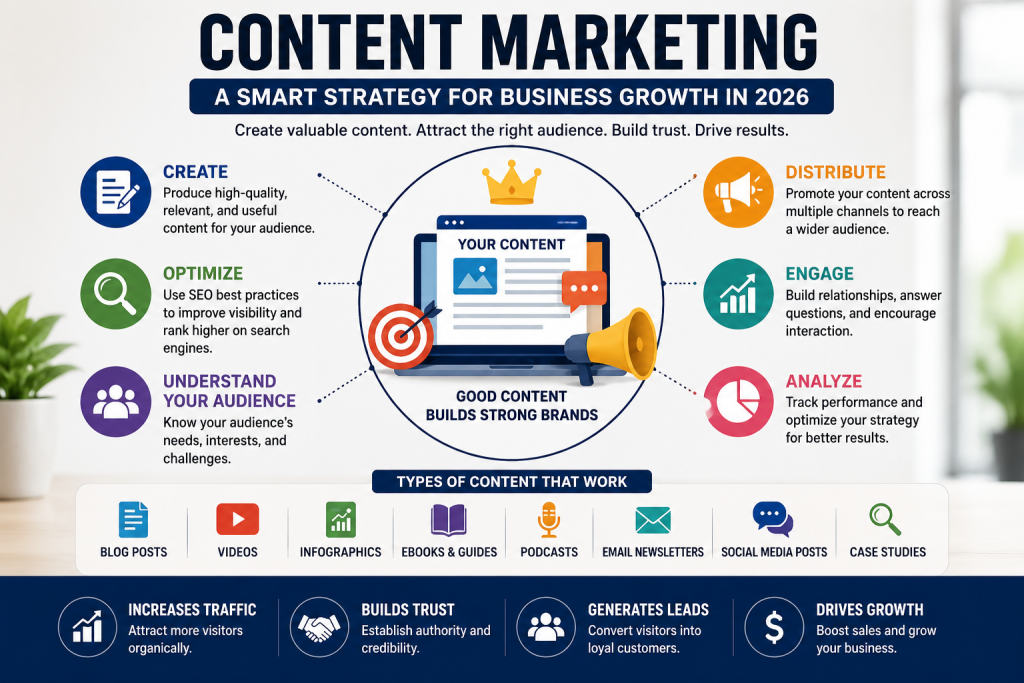
Content Marketing Trends for 2026
As digital marketing evolves, Content Marketing continues to adapt to changing consumer expectations and search engine algorithms.
A modern marketing strategy should include a mix of formats such as:
- Blog articles
- Videos
- Case studies
- Podcasts
- Email newsletters
- Interactive content
- Industry reports
Businesses that diversify content formats can reach broader audiences while increasing engagement across multiple channels. In 2026, brands that prioritize helpful, user-focused content are expected to achieve stronger organic growth.
Measuring Content Marketing Success
Tracking performance is essential for improving Content results over time. Businesses should regularly monitor key metrics to understand what content generates the greatest impact.
Important metrics include:
- Organic traffic
- Keyword rankings
- Click-through rates
- Lead generation
- Conversion rates
- Time on page
- Engagement metrics
By evaluating these indicators, companies can identify opportunities for improvement and make data-driven decisions that support long-term growth.
Common Mistakes to Avoid
Many organizations invest in Marketing but fail to achieve desired results because they overlook critical fundamentals.
Common mistakes include:
- Publishing inconsistent content
- Ignoring audience intent
- Focusing only on promotional messaging
- Neglecting SEO optimization
- Failing to track performance
- Producing low-quality content
Avoiding these issues can improve effectiveness and increase return on investment.
Conclusion
Marketing remains a powerful growth engine for businesses across the United States. Companies that implement a strong content marketing strategy can attract qualified traffic, build authority, strengthen customer relationships, and generate sustainable results.
As competition increases in 2026, businesses that focus on creating valuable, relevant, and user-focused content will be positioned for long-term success. Investing in Marketing today can help establish a stronger digital presence and create lasting competitive advantages for the future.